
He left Venice a teenager with sand in his shoes and questions in his pockets. He came back nearly a quarter century later with a beard, a bundle of jewels stitched into his coat, and a head full of stories that would tilt the maps of Europe. Marco Polo did not discover Asia, and Asia certainly did not need discovering, but his words stitched distant worlds together. If you listen closely, you can still hear the creak of camel saddles on the Taklamakan, the whisper of paper money snapping like leaves, and the hum of a Mongol court that ruled from the Yellow Sea to beyond the Pamirs. His life is not a fable, though fables clung to him like burrs. His book is not a diary, though it changed how Europeans pictured the world. In between is the man himself, a Venetian who learned to look carefully, to ask, and to tell.
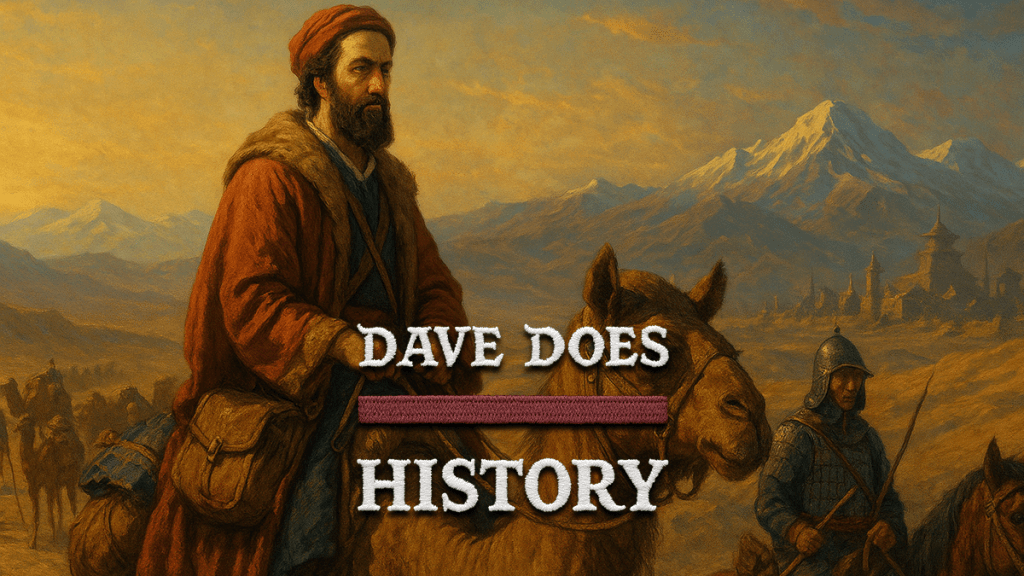
Marco Polo grew up in a city that taught its sons to count, bargain, and sail. Venice was a republic that measured power in oars and ledgers, and the Polo family had both. His father, Niccolò, and uncle, Maffeo, were already moving along the trade routes of the Black Sea when Marco was a boy. They saw early that power was shifting in Constantinople and took the wise merchant’s path. They liquidated assets, converted wealth to jewels, and rode for the Volga, where Berke Khan held court. In a world where a wrong wind or a bad succession could erase a fortune, the brothers prospered, doubled their stake, and pressed farther east. Along the way they reached a summer court at Shangdu, the place later dressed in the Englishman’s dream as Xanadu, and met Kublai Khan, who sent them home to fetch priests and holy oil and news of the strange world beyond the Mediterranean. When they reached Venice again, a teenage Marco finally met the father he hardly knew. That reunion would not last long.
Venice equipped its boys with useful tools. Marco learned how to weigh cargo, assess currency, and keep accounts that balanced. He learned the Latin Church’s frame for the world and the languages that mattered in trade. A smart merchant understood not just numbers but people, and he would have sharpened both on Venetian docks that smelled of brine and pepper and silk stuffed into bales. The city taught him a simple creed. Go. See. Bring back something worth the risk.
In 1271 he set out with his father and uncle. The priests assigned to accompany them turned back early. The Polos did not. They sailed to Acre and then chose the long road rather than the unreliable sea passage at Hormuz. They crossed deserts that Marco later called surpassingly arid and climbed into the high light of the Pamirs, where air thins and thought sharpens. In Badakhshan, he fell ill, perhaps malaria, and stayed for months until the mountain climate and time let him recover. From there the roads narrowed into the oases along the southern edge of the Taklamakan through Yarkant and Hotan and Lop. They moved east, city by city, scripture by scripture, finding Buddhists, Nestorian Christians, Manichaeans, and Muslims along a chain of markets and shrines. Finally, they reached the borderlands of China, after three and a half years of dirt, sun, cold, and calculation. The sacred oil from Jerusalem and a sheaf of papal letters waited in their baggage like passports.
They entered a court unlike any in Christendom. Kublai Khan liked useful minds, and Marco showed he had one. He did not arrive with Chinese characters written on his tongue, but he was quick with the languages of the empire’s arteries, from Turkic speech to Arabized Persian and Uighur. Kublai sent him outward, again and again, on missions that required a steady eye and a merchant’s memory. Marco crossed south into Yunnan and may have brushed the borderlands of Burma. He followed the riverine roads of the southeast to Hangzhou, the city he later praised with such admiration that European readers could taste its markets. He served as inspector of revenue, learning how a state uses salt and paper to govern. He learned what every good traveler learns. Money is paper because people agree it is, and a government that stamps its will on pulp can pay armies, pave roads, and knit regions into a single market. He may have governed Yangzhou, or he may not have. The claim rests on a hinge of translation. What matters is that in the Yuan realm, foreigners were trusted with work the rulers were wary of giving to their subjects, and this Venetian found a place in that mosaic.
The book that would make him famous is careful about one thing. It separates what he saw from what he heard. Even so, rumors sneak in. A court is a hive of stories. Marco wrote of salt pans and paper currency with a clerk’s certainty, and those sections ring precisely against Chinese records. He wrote of vast cities and a ruler’s mercies and terrors in ways that make sense to historians. He also told tales that smell of the bazaar. A traveler’s duty is to be honest about which is which, and to his credit he usually was. The court delighted in him because he observed, remembered, and reported. Kublai kept him close for the same reason. Knowledge about the empire’s edges was a weapon, and Marco was a reliable scout.
Years passed. Courts move but they also stiffen. Kublai grew old, and the Polos grew prudent. It is wisdom, not cowardice, to leave before the next emperor decides that yesterday’s foreign favorites are today’s loose threads. The chance came when a Mongol princess, Kököchin, needed escort to Persia to marry Arghun Khan. The Polos asked to join the convoy and were granted permission. They sailed from Quanzhou with a fleet large enough to make a European admiral stare. Monsoon logic forced them to wait out storms on Sumatra for months. By the time they crossed into the Indian Ocean and angled up toward the Persian Gulf, disease and bad water and the simple arithmetic of ocean risk had eaten most of their company. Of some six hundred who started, only a small handful survived. The princess reached Persia only to learn that Arghun was dead; she married his son Ghazan instead. The Polos turned their faces toward home.
At Trebizond, within Christian lands, they were robbed, a bitter little parable tucked into a long journey. They made their way through Constantinople and finally back into the watery cradle of Venice in 1295. Imagine knocking on a family door after twenty four years. Imagine faces trying to fit your eyes and voice into a memory of a youth who left. The story of their unmasking, slicing open the seams of their travel garments to spill out jewels, has been told so often that it might as well be true. It feels like Venice. It fits the men they had become.
Peace does not last on the Adriatic. Venice and Genoa disliked each other in the way that rich rivals do. Marco, now a citizen again, went to sea and was captured. In a Genoese prison he found a roommate, Rustichello da Pisa, a writer of romances with a good ear for the market. Marco told his stories. Rustichello wrote them down in the fashionable hybrid language of the day. The result is a book that was never meant to be a memoir and was always meant to be useful. It was a description of the world as experienced by a merchant in the service of a Mongol emperor, arranged in the tidy boxes that medieval readers liked. The friars translated it. Scribes copied it by the hundreds, with the happy sloppiness of the age before printing. No original text survives. Instead we have a forest of versions in different tongues, each shaded by the copyist who made it. That is not a flaw. It is a clue to how quickly the book spread and how hungrily Europe read it.
Was it true. The question dogged him even in his time. Some read his pages and shook their heads. How could people so recently coached as barbarians run a court as sophisticated as anything in the world. Where is the Great Wall, the tea, the chopsticks. The answer is less romantic than the accusations. The wall we pose for today is a Ming construction, built long after Marco left, and the Mongol rulers had little reason to love or repair earlier fortifications. Footbinding was regional and far from universal in his day, especially among Mongols, and many travelers failed to mention tea and chopsticks because readers at home did not know enough to ask and copyists did not care to add. Modern scholarship, the patient kind that checks revenues and exchange rates, tends to side with Marco. He was masterful about money, salt, and the mechanics of rule. These are hard to fake and harder to guess. They fit what Chinese records say. If he embroidered his status now and then, he did so in the modest way of a practical man who had left a ruler’s service with his head attached.
There are errors, of course. He miscounted the arches on a famous bridge and the gates in the wall of Khanbaliq. He confused the rigging of the ships that sailed against Japan. He may have allowed Rustichello to lift a flourish or two from an Arthurian romance when a little music would help the prose. But then, every traveler knows the trick memory plays when cities blur and time compresses. What matters is the spine of the story, and the spine holds. The route west to east, the employment, the princess and the hellish sea voyage, the return, the prison dictation, and the rush of translations all make sense. They triangulate from multiple directions. The book’s popularity did the rest. Its pages became sails for other men.
Christopher Columbus sailed with a copy of the book marked in the margins like a student’s primer. He wanted to find Cipangu and Cathay by heading west because men like Marco had written them into reach. Mapmakers drew coasts with greater confidence, and when they did not know, they at least knew where to leave space. In time, a friar named Bento de Goís proved that Cathay and China were the same. The Fra Mauro map breathed with data that had filtered through the Polos’ accounts. Merchants armed with knowledge of spices went looking for them without paying the old middlemen their tax. In a small, important way, Europe began to understand that what lay beyond its horizon was not just rumor but a network of real places with their own logics, economies, and strengths. That recognition does not flatter Europe. It humbles it. Which is a healthy thing.
The man himself lived out his years back in Venice. He married Donata Badoer and had three daughters. He managed his assets with the slow hands of a merchant who had learned the cost of risk. In his will he freed a Tatar servant named Peter. On his deathbed, when someone suggested he take back the marvels, he answered with a sentence that cuts like a sail in a hard wind. I have not told half of what I saw. That line is either bravado or confession. I suspect it is both. A traveler knows when to speak and when to hold back. A writer knows that the page cannot carry everything anyway.
We inherit a long shadow of myths. No, Marco Polo did not bring pasta to Italy. Sicilians were already making durable noodles long before, thanks to Arab influence and durum wheat. The myth sticks because it is neat, and neat stories win bar bets. But the truth is better. He brought something harder to define and far more useful. He brought a way of seeing. He taught readers to accept that the world was wider, richer, and governed by unfamiliar rules that still made sense. He proved that a good observer could make foreign facts feel graspable without turning them into caricature.
His reputation swells and shrinks with fashion. In some eras, he is the golden boy of a Mongol court. In others, he is a braggart who never went further than the next bazaar. The textual mess of his book made it easy for each age to pick a Marco that pleased it. That is alright. History is not a courtroom that renders final verdicts. It is a craft that balances sources and assigns weight. On balance, the details he nails and the patterns that fit carry the day. A careful reading gives him credit where it is due and puts a red pencil through the parts that wobble. That is how grown ups read the past.
There is a human scale to him that I like. The young man learning to listen in a court where a wrong word could end you. The emissary taking the time to study salt because salt is power. The sailor waiting out the monsoon on Sumatra, watching the North Star dip below the horizon and feeling the Earth tilt under his feet. The older man returning to a city whose bells still sound the same and finding comfort in numbers after years when numbers could not save you. You can measure the worth of a traveler by the quality of his attention. Marco Polo paid attention.
His world is long gone, but the habits that made him valuable endure. Ask honest questions. Note the infrastructure that others ignore. Follow the money and the roads that carry it. Learn the words that help people tell you the truth in their language, not yours. Admit what you did not see. Separate the clean facts from the stories you picked up in a market because they were too good to leave behind. Then write it down in a way that invites others to test you. That is as traditional as it gets and as forward looking as anything I can offer.
If you want a moral, it might be this. The world is not a flat map waiting for your flag. It is a crowded house where you are a guest. Walk in with respect. Look. Listen. Pay your bill. And when you come home, tell the truth with as much poetry as you can carry, and with enough precision that the next traveler finds the door you found. Marco Polo did that, well enough that his words still work. For a merchant who never wrote his own book, that is a legacy stout enough to weather the centuries.
He is remembered in many ways that feel both grand and endearingly odd. A sheep bears his name. An airport in Venice moves millions under his sign. Filmmakers, game designers, and television producers keep pulling him off the shelf because there is something evergreen about the boy who goes far, sees much, and brings home a story you can use. Even the children’s game that carries his name hints at what he offered. Call out into the dark. Wait for the answer. Move toward it with care and curiosity. That is the work. That is the point.
He did not chart a new world alone. He walked roads that others built and sailed seas others knew by heart. He learned from officials, monks, sailors, caravan masters, and translators. His gift was to collect, weigh, and pass along what he gathered without trying to make himself the hero of every page. The best kind of travel writing is a mirror angled toward a place, not a torch aimed at the author. That is why Marco Polo still matters, not as a statue on a square but as a set of good habits worth stealing. We need them still. We always will.



 DAVE DOES HISTORY
Leave a comment