
September 12, 1857. The Atlantic roared like an unchained monster, relentless and merciless. For three days a hurricane had pounded a sidewheel steamer off the Carolina coast, and every creak of her timbers told the same story. She was losing. Men worked in bucket brigades, skin pale, lips cracked, passing seawater up from the bilges until their arms gave out. In the engine room, firemen tore apart passenger berths, stanchions, and furniture, anything that would burn hot enough to keep the boilers alive. Women held their children in cabins that sloshed with water, listening to the endless groaning of wood and iron. A miner later recalled, “The sea broke over us in mountains. The vessel quivered as if she would go to pieces every moment.” Everyone aboard understood the truth. Their ship was dying.
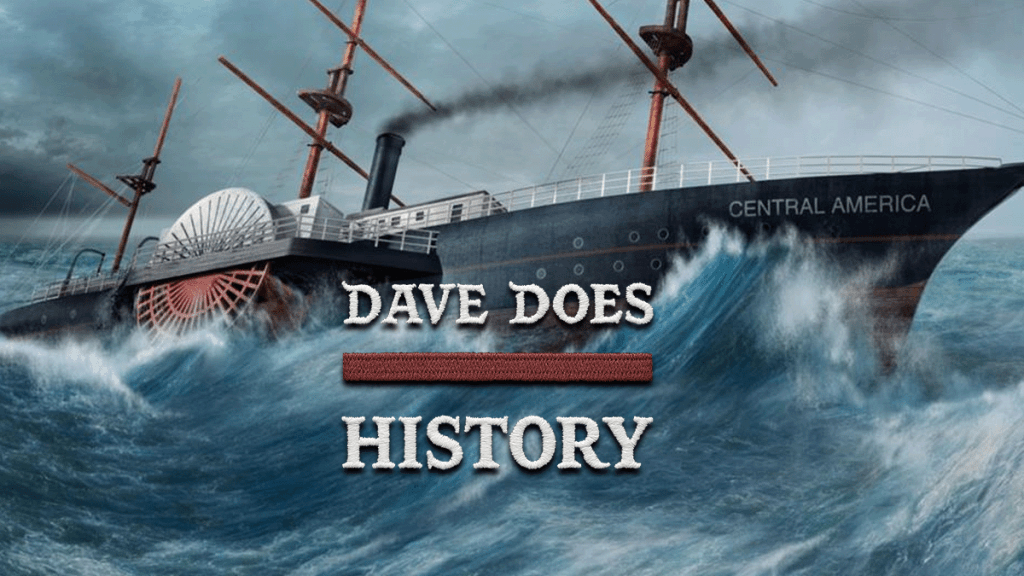
She was the SS Central America, though she was better remembered as the Ship of Gold. Built only four years earlier, she was supposed to be the pride of the United States Mail Steamship Company, a symbol of progress and prosperity. Instead she became the greatest American maritime disaster of her century, taking with her nearly 600 lives and more than a million dollars in gold. She left behind headlines, grief, economic panic, and a legend of courage and futility that has never quite faded.
She had been born in New York in 1853, a product of William H. Webb’s shipyard. At 280 feet long and 40 feet abeam, powered by twin Morgan steam engines that turned paddlewheels the size of houses, she was no lumbering relic. She had been thoroughly recoppered and overhauled just months before her last voyage. But her sleek design carried a flaw that would prove fatal. Instead of a deep hold for ballast, she relied on her coal bunkers for weight and stability. Fine in fair weather, deadly in a storm. And she was crewed not by hardened sailors but by mess boys and stewards who were better suited to serving wine than to serving at sea. The illusion of progress looked fine in a prospectus. Against the Atlantic it was tissue paper.
On September 3, 1857, she left Colón, Panama, bound for New York. Her decks were crowded with passengers, many of them miners returning from the California diggings. Some were flush, carrying fortunes in gold dust and coins; others had little to show for years of labor. But all carried hope. They sewed gold into their clothes, packed it into trunks, wore it heavy in belts around their waists. By the time she left Havana on September 8 she had more than a million dollars in California treasure on board, close to three-quarters of a billion in today’s dollars. Her captain was William Lewis Herndon, a U.S. Navy officer known for his calm resolve. The newspapers praised him as “a man of intellect, of firmness, and of quiet courage.” He was the sort of man you wanted in charge if the sea turned ugly.
And ugly it did turn. On September 9 the weather shifted from a fresh breeze to a howling gale. By the next morning the ship was in the grip of a full-blown hurricane. Survivors spoke of “waves like mountains, striking us on every side,” and of “a sound like thunder as the seas crashed upon the deck.” Water poured in through the paddlewheel shaft. The engineers burned through the last of the coal, then began feeding wood into the boilers. Passenger berths, awning posts, anything that would burn. Still the storm raged.
The bucket brigades formed, lines of men working in silence. One remembered, “We were too weary to speak. Our lips were blackened with salt, our eyes red, our bodies shuddering, but we passed the buckets still.” Another wrote of the surreal moment when miners stripped off their gold belts, throwing them aside. “The decks were strewn with gold,” he said. “It lay like pebbles, shining in the lightning, kicked aside as men fought for planks to cling to.”
By September 11 the fight was lost. The boilers gave out. No steam meant no pumps, no paddlewheels. The ship rolled helplessly on her side, taking blow after blow. Captain Herndon tried storm sails, but the wind tore them to ribbons. He tried dragging an anchor, but it only made her wallow worse. “She was dead in the water, and so were we,” a passenger later said. Some prayed. Some cursed. Some sat in silence, waiting for the end.
On the afternoon of September 12, salvation appeared. The brig Marine came into view, battered by the same storm but afloat. Three lifeboats were launched from the Central America, and in one of the most remarkable moments of the entire disaster, every woman and child aboard was ferried to safety. Witnesses described them climbing down the side of the sinking ship, clutching their children, lowered into boats that bobbed like toys in the massive seas. “It was done with little panic,” one survivor recalled. “There was weeping and praying, but there was order. They were taken away, all of them.”
Captain Herndon could have gone then. He did not. Survivors described him standing bareheaded on the bridge, bowing as the boats pulled away. “He stood like a statue,” one passenger remembered, “serene as if he commanded his own fate.”
That evening, the storm redoubled. At seven o’clock, a massive sea swept across the upper deck. Rockets were fired into the sky as a final plea for help. “Her last rockets went up as she went down,” a survivor said. “It was as if she cried out to heaven before the sea closed over her.” The stern rose, the bow plunged, and the Atlantic swallowed the Ship of Gold whole.
Out of roughly 626 souls, fewer than 110 survived. The rest were gone.
Some clung to wreckage through the night. The Norwegian bark Eloise rescued fifty men in the predawn hours of September 13. The American bark Saxony found five more. One miner, Henry H. Childs, swam for six hours before he was pulled aboard. He later told reporters, “I had given myself up to death many times, but each time something stronger than despair kept me moving.”
When news reached New York, it spread like fire. Newspapers printed extras with headlines that shouted in block letters: TERRIBLE LOSS OF LIFE! SHIP OF GOLD LOST AT SEA! The New York Times wrote, “The nation is stricken with grief. The sea has taken not only our citizens but our treasure.” The loss of life was staggering. The loss of gold was catastrophic. Nearly two million dollars in bullion had been bound for New York banks, and its sudden disappearance helped trigger the Panic of 1857. Businesses collapsed, banks shuttered, thousands were ruined. The Ship of Gold dragged the economy down with her.
Amid the panic, there was still admiration. Captain Herndon’s heroism was celebrated across the country. The New York Herald declared, “He was as firm as a rock, a man whose last thought was for the lives of others.” The Naval Academy erected a monument in his honor. A town in Virginia was named for him. Two Navy ships carried his name into service. In an era that prized gallantry, Herndon became a symbol of duty fulfilled to the bitter end.
For 132 years the Central America lay undisturbed in darkness, eight thousand feet below the waves. Then, in 1988, technology found her. The recovery team brought up bars of gold as heavy as anvils, stacks of double eagle coins, even the great bronze bell stamped with “New York 1853.” The haul was worth more than a hundred million dollars. “To hold a coin that had been at the bottom of the sea for more than a century,” one diver said, “was to hold history itself.”
But the curse of gold lingered. Thomas Thompson, the man behind the recovery, became mired in lawsuits. Investors accused him of hiding profits. He went on the run, was arrested years later, and still faces legal battles. The shipwreck that had ruined lives in 1857 ruined reputations in the 21st century as well.
The hurricane that swallowed the Central America also battered dozens of other ships. Steamers limped into Norfolk with broken masts and flooded holds. Schooners went down off the Carolinas. The steamer Norfolk sank in the Chesapeake, though her captain ensured every woman aboard was saved before he abandoned ship. The storm was a naval battle between the Atlantic and every vessel in its path. The Central America just happened to be carrying treasure, and so she became the story.
She is remembered for her gold, but her real legacy is human. Miners casting aside fortunes. Women and children ferried across raging seas. A captain who bowed farewell before the waves swallowed him. A storm that stripped away the illusion of progress and reminded the world that the Atlantic does not bow to man.
The gold has been recovered. The wreck has been picked over. But the story endures, gleaming brighter than the treasure itself, because it is not about wealth lost. It is about duty, courage, and the fragile line between fortune and fate. The Ship of Gold went down in 1857, but her shadow still glimmers on the water.



 DAVE DOES HISTORY
Leave a comment