
The cannon smoke hung low over the sea, the decks slick with blood and water. The Bonhomme Richard was torn to shreds, listing, burning, and on the verge of sinking. Any sane man would have struck his colors and surrendered. But John Paul Jones wasn’t built like most men. When the British captain demanded his surrender, Jones’s reply became the stuff of legend: “I have not yet begun to fight!”
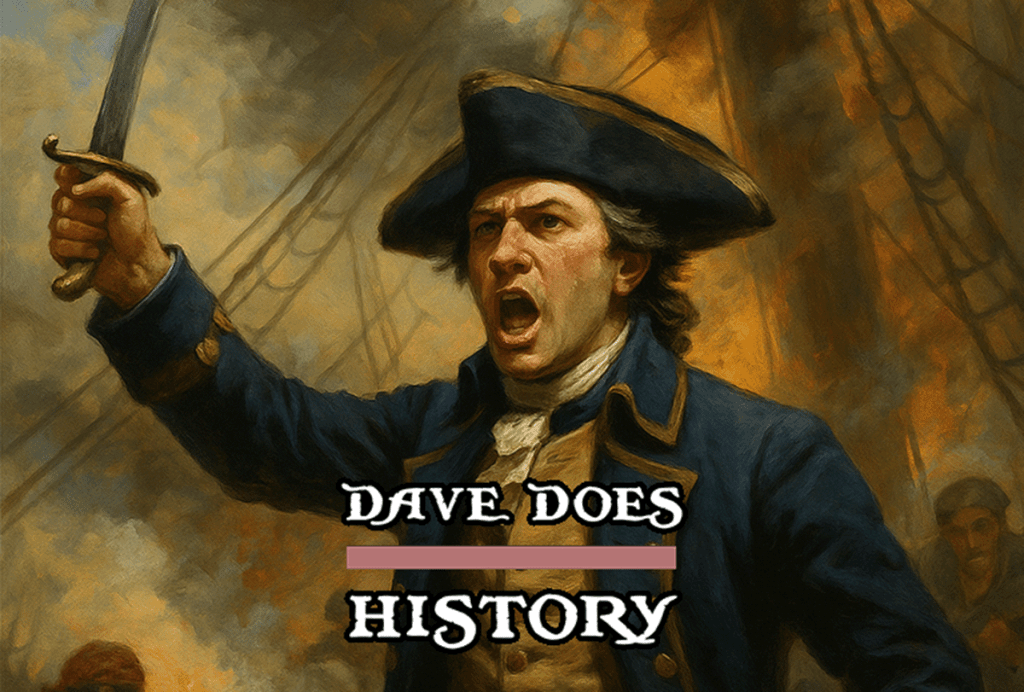
With that defiant cry, a myth was born. He wasn’t just refusing to quit, he was declaring war on defeat itself. Jones would go on to capture the Serapis, one of Britain’s finest warships, even as his own vessel sank beneath his feet. It was a moment of unmatched grit, a defining image of American naval audacity.
But history, like the ocean, is deep and full of currents. Jones’s story doesn’t sail smoothly between heroism and villainy. In America, he’s lionized as the “Father of the Navy,” the first to plant the Stars and Stripes on a warship, and the man who carried the Revolution to Britain’s own doorstep. His victories are studied, his quotes enshrined.
To the British, though, he was a pirate, a sea marauder who raided towns, looted homes, and fled justice. In Russia, where he served briefly as a rear admiral under Catherine the Great, he became a scandal. Accused of sexual assault, hounded by court politics, and ultimately forced into exile, Jones left behind more controversy than glory.
So who was the real John Paul Jones? A visionary warrior driven by freedom, or a restless opportunist chasing personal glory under whatever flag would hoist him? A man of honor, or a man of ambition? The line blurs.
Today, we strip away the marble and myth to look at the man beneath the uniform. It’s a journey through fire and fog, through victories and failures, through fame and disgrace. We’ll trace Jones’s life from his humble beginnings in Scotland to the burning decks of battle, through courts, countries, and the long road to a crypt beneath the U.S. Naval Academy.
Was he a naval genius or a rogue with a good press agent? That’s the question we’re asking. What’s certain is this: John Paul Jones never stopped fighting, to be remembered, to be honored, to matter. And more than two centuries later, he still does.
John Paul Jones was not born with that name, and he certainly wasn’t born into legend. He was born plain John Paul, on July 6, 1747, in a modest cottage on the Arbigland estate near Kirkbean, Scotland. His father was the head gardener for a wealthy landowner, which meant young John Paul came from hard-working stock, but not a drop of nobility. The world he entered was rough, rural, and unremarkable, hardly the kind of place you’d expect to produce a man whose bones would one day lie beneath the marble floors of the U.S. Naval Academy.
Like many boys along the western coast of Britain, he looked to the sea. At just thirteen years old, he signed on as a cabin boy aboard the Friendship, sailing out of the port of Whitehaven. That’s where his maritime education began. He learned to rig a sail, coil a rope, and survive a sailor’s brutal life. Long hours. Harsh discipline. The constant thrum of death by storm, by disease, or by the lash. It was a hard school, but John Paul proved a fast study. He rose through the ranks, serving aboard various merchant vessels, some bound for the West Indies, others down Africa’s deadly coast.
By 1764, still not yet twenty, he was working aboard the King George, a slave ship. Two years later, he transferred to the Two Friends, a fifty-foot slaver out of Jamaica, and was made first mate. It was grim work. Shackled Africans packed like cargo below deck. Death and misery as routine as the tides. Years later, Jones would refer to the slave trade as “an abominable trade,” and there’s reason to believe he meant it. In 1768, after several runs between West Africa and the Caribbean, he abruptly quit the business. Maybe his conscience finally won out. Maybe the danger became too much. Or maybe he just saw the winds changing and jumped ship before the tide turned against the slavers.
Whatever his reasons, his career didn’t slow. In 1768, John Paul took passage home to Scotland aboard the brig John, but during the voyage disaster struck. Both the captain and the chief mate died of yellow fever. Just twenty-one years old, Paul stepped up. He navigated the ship to safety, brought her into port, and so impressed the owners that they named him master and gave him ten percent of the cargo. It was a remarkable ascent for a former cabin boy, and it looked like the beginning of a long, respectable career.
But respectability doesn’t always last.
In 1770, on his second voyage commanding the John, a pay dispute broke out with one of his sailors. Paul had the man flogged for insubordination, and the man died shortly after. Local authorities investigated. John Paul insisted he had acted within his rights as a captain and that the punishment had not caused the man’s death. But the sailor came from a prominent Scottish family, and rumors swirled. The shadow of murder clung to him. Though no charges were filed at the time, the stain remained. He went back to sea, but his reputation had changed. He was no longer the promising young master. He was the man who killed a sailor.
He tried to rebuild. In 1772, he took command of the Betsy, a London-registered brig operating in Tobago. The ship was armed, her business speculative, and her cargo as volatile as her crew. For a while, things went smoothly. But in 1773, lightning struck again. A mutiny flared up over unpaid wages. In the chaos, Paul drew his sword and killed one of the ringleaders. This time, he didn’t wait for charges. He knew what was coming. He packed his things and fled the island, disappearing into the British colonies in North America.
When he reappeared, it was under a new name: John Paul Jones.
The name change wasn’t just about hiding. It was a reinvention, a clean slate. Some believe he chose “Jones” in honor of Willie Jones, a radical political figure in North Carolina. Others say he simply needed a new identity to avoid extradition and picked something common enough to disappear into. Either way, by the time he arrived in Fredericksburg, Virginia, to settle the estate of his deceased brother William, John Paul was gone. John Paul Jones had arrived.
He bought land in Frederick County, made new connections, and tried to build a new life. He even courted Dorothea Dandridge, the future wife of Patrick Henry. He dressed sharply, moved with confidence, and spoke with a lilting Scottish brogue. His manners were polished, his ambitions outsized. He was intense, proud, and carried himself like a man born to command, not one running from a past stained with blood.
And yet, that past never truly let go. The whispers of murder followed him, even in Virginia. But so did something else. When the storm of revolution broke over the colonies in 1775, Jones found his moment. He wasn’t just looking for refuge anymore. He was looking for a cause, a flag, and a second chance.
The fledgling Continental Navy was in desperate need of men who knew the sea. Officers were scarce. Ships were fewer. But ambition was welcome, and Jones had it in spades. With a push from political allies like Richard Henry Lee, Jones was offered a commission as a lieutenant aboard the Alfred. On that ship, he would raise the very first American naval ensign. From that moment on, he would not just be a sailor, he would be a symbol.
Still, the name “John Paul Jones” remained a loaded one. Some saw a hero-in-the-making. Others saw a killer cloaked in patriotism. He had charm, but also arrogance. Discipline, but little tolerance for fools. He wrote poetry. He chased women. He spoke French, sometimes poorly, but always confidently. Above all, he wanted recognition. Glory. Immortality.
He would soon get his wish. But before the cannon fire and famous quotes, before the medals and monuments, there was this: a gardener’s son from Scotland, whose life at sea was marked by death, reinvention, and an unshakable drive to matter. From Kirkcudbright to the colonies, John Paul Jones was already charting a course that would make him one of the most controversial and unforgettable figures in American history.
When war came to the colonies, it came fast, loud, and desperately short on warships. The Continental Congress, scrambling to build a navy from scratch, was in dire need of officers who could do more than polish brass and salute. They needed men who knew how to sail, how to fight, and how to survive. John Paul Jones, new name, new cause, fit the bill.
Thanks to a timely recommendation from Richard Henry Lee, one of Virginia’s leading voices in the Continental Congress, Jones was brought into the fold. He had charm, presence, and above all, seafaring experience. That counted for a lot in a navy that, in December of 1775, barely had enough ships to be called one. Jones was commissioned as a first lieutenant aboard the Alfred, the Continental Navy’s very first flagship. The ship wasn’t much to look at by Royal Navy standards, but it carried a bold new banner, one that Jones himself had the honor of raising. The first U.S. naval ensign flew over her deck, and the young Scottish exile was now officially part of the American Revolution.
Jones didn’t waste time blending in. His ambition made waves immediately. While serving aboard the Alfred, he impressed senior officers with his tireless work ethic, sharp navigational skills, and fiery spirit. He wasn’t just along for the ride, he wanted command. He wanted to fight.
In 1776, he got his wish. Jones was promoted to captain and given command of the sloop-of-war Providence, a small but nimble vessel that packed more punch than her size suggested. This was the proving ground he’d been waiting for.
Over the course of just a few months, Jones turned the Providence into a nightmare for British shipping. Between August and October, he crisscrossed the Atlantic from Bermuda to Nova Scotia, launching hit-and-run attacks, evading British frigates, and piling up the kind of victories that got noticed in Philadelphia and feared in London. He captured or sank enemy ships with almost surgical precision, eight burned or sunk outright, another eight taken as prizes. That was no small feat for a navy that still had more ambition than resources.
One voyage alone netted sixteen British prizes. Sixteen. Each prize was a captured merchant or enemy ship, hauled back under American control to be sold or repurposed. Those victories didn’t just make headlines. They made money, supplied goods, boosted morale, and proved that American captains could outwit and outfight their British counterparts. It also cemented Jones’s reputation as one of the navy’s most aggressive and effective commanders.
He didn’t just hit the British where it hurt, he did it with style. He maneuvered through hostile waters with the confidence of a man who had been preparing for this all his life. He often went right up against superior firepower, betting that his cunning, speed, and sheer nerve would make the difference. And more often than not, it did.
His raids on Nova Scotia were particularly bold. He struck at fisheries, shipping lanes, and coastal outposts. These weren’t just strategic attacks. They were psychological warfare. They reminded the British that the war wasn’t confined to American soil. Their own coasts were vulnerable. Their own people could hear the thunder of American guns.
Jones’s aggressiveness didn’t come without friction. He clashed with fellow officers and superiors. He pushed the limits of his authority. He didn’t suffer fools and made it known. But for all the sharp edges in his personality, no one could deny the results. He was doing what the Continental Navy desperately needed, scoring wins, capturing ships, and proving that the new nation’s fight wasn’t limited to the land.
In the midst of this success, Jones was briefly reassigned back to Alfred, where he once again proved his worth by bringing in a string of captured vessels. Whether on a sloop or a larger ship, Jones had a knack for turning the tide in America’s favor.
He wasn’t just out for blood. He was out to build something. He understood that the Revolution would be won not just by armies, but by controlling the seas. Every British ship captured, every supply line disrupted, every convoy scattered, that was part of the bigger picture. Jones wanted the American Navy to be more than a handful of rebellious ships. He wanted it to be a force. A statement. A future.
And he wanted to be the one leading it.
By the end of 1776, Jones had already made himself indispensable. While others were still learning the ropes, literally, he was carving a path forward with cannon fire and courage. In just a year’s time, he had gone from fugitive Scotsman to one of the brightest stars in the fledgling American Navy.
But the sea had more in store for him. Bigger ships. Bigger battles. And bigger trouble. Jones was far from done. The Revolution was heating up, and John Paul Jones was ready to light more fires.
By the spring of 1778, John Paul Jones was growing restless. The victories aboard Providence and Alfred had proven his skill, but they hadn’t satisfied his hunger. He wasn’t content raiding ships along the fringes of the war. He wanted to strike at Britain’s heart, to show the Crown and the English people that nowhere, not even their own harbors, was safe from the reach of American vengeance.
Commanding the Ranger, a newly built Continental sloop-of-war, Jones crossed the Atlantic and prowled British home waters like a wolf off the leash. The very idea of a Continental Navy ship sailing unchallenged through the Irish Sea and along England’s coastline was almost unthinkable to the British. That was exactly why Jones did it.
On the night of April 22, 1778, he set his sights on Whitehaven, the very port he had sailed from as a boy. He knew it well. He knew the layout, the tides, the watch schedules. And he intended to burn it to the waterline.
The town’s harbor was packed with over 200 wooden merchant ships, many of them used to supply coal and war materiel to the British fleet. If Jones could destroy even a portion of them, the blow would be both practical and symbolic. It would shake British confidence, terrify civilians, and force the Royal Navy to divert ships away from America to guard the home front.
Jones took two boats and a detachment of men ashore in the dead of night. But things started going wrong almost immediately. The wind shifted against them. The tide was ebbing. And some of his men, once ashore, decided it was a perfect time for a drink. They raided a nearby pub, delaying the mission long enough for the sun to begin rising over the town.
With dawn breaking, the window for a covert operation was closing fast. Jones and a few determined crewmen managed to spike the town’s main defensive cannons, driving iron spikes into the touchholes to render them useless. Then they tried to ignite the ships. But the lanterns they had brought had run out of fuel, and attempts to steal some from the public house were only partially successful. They set fire to one coal ship, but townspeople quickly raised the alarm, rushing to extinguish the blaze with fire engines.
Realizing the element of surprise was gone, Jones withdrew. The raid had failed to achieve its destructive aims, but its psychological effect was enormous. The British press howled in indignation. Parliament was rattled. A full-scale attack on a British town by an American warship? That hadn’t happened in centuries. The Royal Navy was humiliated. For the first time, the British public felt the war at their doorstep.
Jones wasn’t finished.
Barely a day later, he sailed the Ranger across the Solway Firth to the Scottish estate of the Earl of Selkirk on St. Mary’s Isle. This time, the goal wasn’t destruction. It was capture.
Jones hoped to seize the Earl himself and hold him as a hostage to bargain for the release of American prisoners languishing in British jails. It was a bold plan. But again, things didn’t unfold as he intended. The Earl was away. Only his wife, the Countess of Selkirk, and their staff were present.
Jones, perhaps worried about losing control of his crew or returning empty-handed, allowed his officers to go ashore anyway. They entered the estate, unarmed and polite, and explained that they had come for the Earl but would be leaving with a different form of ransom, his family’s silverware.
The Countess, to her credit, handled the situation with dignity. She oversaw the removal of her silver personally, ensuring that only the plate was taken and nothing else. No one was harmed. No damage was done. The incident, while humiliating for the family, was oddly genteel, almost surreal.
Jones later regretted the theft. In his mind, it was a lapse in honor. He had no personal use for the silver, nor did he consider it an appropriate prize. When the war ended, he bought the silver back from a Paris auction and returned it to the Selkirk family with an apology and a note explaining his motives.
To some, that act proved Jones was a man of principle. To others, it was just damage control from a man who knew he’d overstepped. Either way, the damage was done. The story of the Selkirk raid, and the silver theft, made headlines across Britain and America. Some praised it as a clever act of war. Others condemned it as the behavior of a pirate. Rudyard Kipling, writing years later, would mock Jones as a bloodthirsty raider, little better than a corsair.
That image, half-hero, half-pirate, would stick with him for the rest of his life.
But from a strategic point of view, Jones had achieved something remarkable. He had forced the British to look over their shoulder. He had shown that the Revolution wasn’t just a colonial rebellion. It was a global fight, with a navy bold enough to reach into the lion’s den. His raids weren’t just naval skirmishes. They were statements. Loud, brash, unforgettable statements.
They said: We are here. We are coming. And we will not be ignored.
And if that meant burning a ship, stealing some silver, or humiliating a noble, so be it. For John Paul Jones, the ends justified the cannon fire.
John Paul Jones had never been a man particularly fond of compromise, and by 1778, that trait was starting to rub even his allies the wrong way. His command of the Ranger, while bold and successful, was also marked by rising tensions, especially with his second-in-command, Lieutenant Thomas Simpson. The two were oil and water from the start, Simpson was cautious, Jones aggressive; Simpson wanted order, Jones craved glory. They were both competent, but only one ship had a wheel.
In April of that year, while prowling off the Irish coast, Jones received intelligence that HMS Drake, a British sloop of roughly equal firepower, was anchored off Carrickfergus. Jones wanted blood. He steered the Ranger directly into confrontation. On April 24, 1778, the two ships clashed in the North Channel. In an hour-long duel, Drake was battered into submission. Its captain was killed. Its crew was stunned. It was, by all counts, a triumph.
But as the Ranger limped back toward France, Jones’s feud with Simpson exploded. The Drake had been entrusted to Simpson, who separated from the Ranger en route to Brest. Jones, incensed by what he saw as insubordination and possible cowardice, had Simpson arrested and ordered court-martialed. The charges didn’t stick. John Adams, in France at the time, reviewed the case and sided with Simpson. In truth, Adams found Jones tiresome, brilliant, yes, but arrogant, and prone to picking fights with those around him.
Still, Congress recognized results. Jones was dangerous, unpredictable, and combative, but he got things done. And in war, results often matter more than manners. So in 1779, when the chance came to lead a multinational squadron on a high-stakes mission, Jones was given command of the Bonhomme Richard, an aging French merchant ship converted into a war vessel. She wasn’t pretty. She wasn’t fast. But she was his.
The mission was audacious: to lead a small Franco-American squadron around the British Isles and intercept a Baltic convoy loaded with cargo vital to the Crown. With Jones aboard Bonhomme Richard were the Alliance (an American frigate under Captain Pierre Landais), the Pallas, the Vengeance, and a few French privateers. From the beginning, the expedition was plagued by internal squabbles. Jones clashed constantly with Landais, who fancied himself a naval genius and ignored orders whenever possible. The squadron, though allied in name, functioned more like a reluctant committee.
Still, Jones pressed on. By September, they’d made their way along the east coast of England. On the evening of September 23, 1779, off Flamborough Head, he spotted his target. A large British convoy was being escorted by two warships, the 44-gun Serapis and the smaller Countess of Scarborough. Jones engaged.
What followed was one of the most brutal, chaotic, and legendary sea battles in American naval history.
As Bonhomme Richard approached Serapis, the two ships opened fire at close range. It was immediately clear that Serapis had the superior firepower. Her cannons were newer, her hull stronger. Bonhomme Richard began taking heavy damage almost instantly. Two of her old guns exploded on their first discharge, killing the gun crews and wrecking the battery deck. Jones realized quickly that he couldn’t outgun the British ship. He’d have to outfight her.

So he rammed the Serapis, lashing the two ships together in a death embrace. Now the fight was hand-to-hand, musket to musket, sword to sword. Marines on both sides climbed into the rigging, sniping down with muskets. Grenades rained from above. The ships groaned and splintered against each other in the moonlight, locked in a floating cage match with nowhere to run.
At one point, seeing the American ship burning and listing, the captain of Serapis, Richard Pearson, called out to ask if Jones was ready to surrender. That’s when history gave us its most iconic line.
“I have not yet begun to fight,” Jones reportedly snapped back.
The quote may not be verbatim, accounts vary, but the spirit of it was real. Jones had no intention of quitting. He ordered his men to keep firing. A grenade thrown from above exploded a stockpile of powder on Serapis, killing dozens of British sailors. Slowly, methodically, Jones’s crew gained the upper hand.
Meanwhile, the Alliance, under Landais, circled at a distance, firing erratic broadsides that struck both British and American vessels. Whether by incompetence or malice, Landais did more damage to his own side than to the enemy. Jones later called his actions disgraceful. But despite that, and despite the near-total destruction of his own ship, Jones was winning.
After more than three hours of savage combat, Pearson struck his colors. The Serapis had been beaten. Barely. Jones’s own ship, the Bonhomme Richard, was so badly damaged it began to sink beneath him. He transferred his flag to the Serapis, his prize, and watched as the vessel that had carried his name to glory slipped beneath the waves.
The victory electrified France and America. In Paris, Jones was received as a hero. King Louis XVI awarded him a gold-hilted sword and named him a Chevalier of the French court. The Continental Congress struck a gold medal in his honor. The British, on the other hand, were aghast. Their coastal defenses had failed. Their merchant fleet had been endangered. And a rogue American captain had stood toe-to-toe with a superior ship and won.
Back in England, caricatures of “Paul Jones the Pirate” spread through newspapers and broadsheets. They mocked him as a black-hearted raider. But the fear was real. Jones had taken the fight to the empire’s doorstep, and won.
The legend of John Paul Jones was now fully formed. Not just because he’d won a battle, but because of how he fought it. He didn’t surrender when it made sense. He didn’t retreat when defeat seemed certain. He clung to the side of his enemy like a barnacle with a grudge and brought the entire ship down with him.
He proved that American sailors were not to be dismissed. He showed that defiance, grit, and courage could outweigh firepower and polish. He became the model for the kind of fighting spirit the U.S. Navy would carry forward for generations.
Of course, Jones’s triumph didn’t make him easier to work with. His feud with Landais grew worse. Political allies tried to rein in his ego. And while he was celebrated in France and tolerated in America, he never received the command or recognition he thought he deserved.
But on that cold September night in 1779, John Paul Jones didn’t just win a naval engagement. He etched himself into the very soul of American naval identity. His ship may have sunk, but his name would rise.
Because when everything was burning, when his own vessel was falling apart, when the smart move was to give up, Jones stood tall on the blood-soaked deck of his enemy’s ship and shouted to the world that he had only just begun.
And the world remembered.
Victory made John Paul Jones famous, but fame didn’t bring him peace. After the triumph at Flamborough Head, he was the toast of Paris. French salons buzzed with tales of the dashing American captain who had bested the Royal Navy in their own backyard. King Louis XVI knighted him and presented him with a gold-hilted sword, naming him Chevalier Paul Jones. For a poor gardener’s son from Kirkcudbright, it was a moment that should have marked the peak of his career.
Back in America, Congress was slower to applaud, but eventually came around. In 1787, Jones was awarded the Congressional Gold Medal, a rare and coveted honor. He had helped elevate the fledgling United States Navy from backwater nuisance to a force capable of humiliating the greatest maritime power on Earth. He had earned respect, if not always affection.
But respect didn’t translate into command.
The ship America, a newly constructed 74-gun warship and the crown jewel of the Continental Navy, was promised to Jones. It was the culmination of years of blood, sacrifice, and grit at sea. But when the French asked for a ship to replace one they had lost, Congress handed America over to them instead. Just like that, the ship that bore Jones’s ambitions sailed away without him. No fanfare. No ceremony. Just another slight in a career full of them.
Jones, ever the man of volcanic pride, was furious. He believed his service entitled him to leadership of a modern fleet, not scraps from political deal-making. But Congress had never fully trusted him. He was too bold, too foreign, too proud. His critics saw a glory-hound. His admirers saw a visionary. His country saw a problem.
Still, Jones didn’t quit. He kept writing letters, pressing for a new commission, trying to stay in the game. He had risked everything for a country that now seemed eager to shelve him. The Revolution had been won, but for John Paul Jones, the war for recognition, and redemption, was far from over.
By the late 1780s, John Paul Jones had become an international man without a country. America no longer knew what to do with him. France had honored him, yes, but had no pressing need for his services. He’d won battles, worn medals, and dined with kings, but he wasn’t in command of a single ship. That’s when the unlikely offer came from the east, from Russia.
In 1787, Catherine the Great invited Jones to join her Imperial Russian Navy. She was engaged in a war against the Ottoman Turks and needed seasoned commanders to bolster her fleet in the Black Sea. Jones accepted with little hesitation. He was given the rank of rear admiral and a name he despised, Pavel de Zhones. It was a fresh uniform, a fresh cause, and, he hoped, a fresh start.
But Russia was no republic. It was a land of intrigue, backstabbing courtiers, and generals who saw foreign officers as little more than political threats. Jones was welcomed into the fleet, but not into the fold. He found himself surrounded by rival officers who mocked his accent, dismissed his record, and did everything possible to undermine him.
Despite these obstacles, he performed admirably. In 1788, he led a squadron during a critical engagement against the Turks, where his tactics helped repel the enemy fleet and secure a key Russian position. But instead of being praised, his reports were buried, his victories credited to others. Jealousy ran deep. Russian officers didn’t like an American, particularly one who made no secret of his pride, earning accolades on their turf. His enemies whispered, lied, and schemed. And it worked.
In 1789, the whispers became a roar.
Jones was accused of raping a 10-year-old girl in St. Petersburg. The girl’s mother brought charges against him, and soon, the entire imperial court was abuzz with scandal. Jones was arrested and interrogated. He denied everything, insisting the charges were fabricated by political enemies. Some accounts suggest he may have had a consensual relationship with a young, though not underage, servant girl, but the truth has always been murky. What is clear is that Catherine the Great didn’t want the scandal dragging her navy through the mud.
Rather than see Jones imprisoned or executed, she quietly arranged for his release. The charges were neither proven nor dismissed. They were simply buried. He was quietly told to leave Russia. He was never offered another command.
And just like that, the great American sea hero, the man who had captured the Serapis, terrorized British ports, and dared to bring war to England’s doorstep, was disgraced, adrift, and unwanted.
Back in Europe, the news traveled fast. Diplomats gossiped. Former friends turned cold. Even those who had admired his boldness now kept their distance. The scandal had poisoned his name. He wasn’t seen as a hero anymore, but as a dangerous and possibly immoral relic of a violent era.
Jones spent his final years in Paris, wandering through salons where he was once a star but now a fading presence. He wrote letters to American officials, still begging for a new command, still offering his services to the republic he’d helped to create. He even tried to clear his name from the Russian allegations, but no one seemed to be listening.
His health began to fail. He suffered from kidney problems and edema. He drank more. His letters became more erratic, tinged with bitterness and desperation. The fire that had once made him fearless now made him lonely. The world had moved on, and John Paul Jones was left behind.
He died alone in a Paris apartment on July 18, 1792. He was 45. No flags were lowered. No ships fired salutes. He was buried in a modest grave, forgotten by the revolution he had fought for and discarded by the empires he had tried to serve.
It would be more than a century before America would remember what he’d done and bring his bones home. But in his final years, John Paul Jones knew what it felt like to be cast off, not as a rogue, but as a man who had given everything and received, in the end, almost nothing.
John Paul Jones may have fought like a lion at sea, but he died like a ghost on land. By 1792, the man who once terrified the Royal Navy was living quietly in Paris, far from the decks where he had made his name. He had no ship, no commission, and no home to call his own. His health was failing, worn down by years of stress, drink, and disappointment. His reputation, once the pride of two continents, had been darkened by scandal and obscured by time.
Still, hope flickered. Just before his death, Jones received a diplomatic appointment from President George Washington himself, U.S. consul to Algiers. It wasn’t the fleet he had begged for, but it was a chance to serve again, a chance to matter. He never made it. On July 18, 1792, Jones died alone in his Paris apartment, likely of kidney failure. He was 45.
With no family and few friends left, he was buried in a Protestant cemetery on the outskirts of Paris, his body placed in an unmarked coffin filled with alcohol to preserve it. The grave had no marker, no ceremony, no recognition. For over a century, John Paul Jones, the man who shouted down surrender and carved his name into naval legend, was lost beneath the soil of a foreign land, forgotten.
Then came Theodore Roosevelt.
In the early 1900s, as Roosevelt worked to transform the U.S. Navy into a modern force, he looked backward to find heroes worthy of the Navy’s heritage. At the top of that list stood John Paul Jones. Roosevelt believed in greatness, and Jones, flawed, fiery, relentless, fit the mold perfectly.
Roosevelt ordered a search. It took six years, the efforts of the American ambassador to France, and the excavation of multiple graves. In 1905, Jones’s remains were identified thanks to a death mask, preserved records, and the alcohol that had kept his body intact. A French pathologist confirmed the identity. The bones of the nation’s first sea hero had been found.
Roosevelt pulled out all the stops.
Jones’s body was returned to the United States aboard the USS Brooklyn, escorted by an entire naval squadron. In 1913, he was reinterred with full honors in a crypt beneath the U.S. Naval Academy in Annapolis, Maryland. His new tomb, crafted from marble and bronze, glows under golden light, guarded by midshipmen who are taught his name from the moment they arrive. The man who had died alone in obscurity was now entombed in glory.
Roosevelt’s vision had worked. He resurrected not just a body, but a legacy. Jones became the spiritual father of the Navy, a symbol of fearless defiance and undying resolve. His quote, whether apocryphal or not, became a battle cry: I have not yet begun to fight.
And it still echoes.
In the end, John Paul Jones didn’t live long. He didn’t die rich. He wasn’t universally loved. But he did something few men ever do, he made history, and then refused to be buried by it. It took more than a century, but the country he fought for finally brought him home.
John Paul Jones is the kind of figure history can’t quite make up its mind about. To some, he’s the “Father of the American Navy”, the first and fiercest champion of a sea force that could stand up to empire. To others, he’s a pirate in patriot’s clothing, a man whose vanity rivaled his courage and whose scandals never quite stayed below deck.
Even in his own time, he split opinion like a cannonball splits a mast. George Washington respected his skill but kept his distance. John Adams thought him arrogant and undisciplined. French admirers praised his gallantry, while British papers cartooned him as a blood-drenched corsair. He could be reckless, he could be brilliant. He could be noble, he could be self-serving. He was, in the best and worst sense of the word, unforgettable.
He has lived on not just in statues and ships but in stories. James Fenimore Cooper and Alexandre Dumas both took turns fictionalizing his life, painting him as a romantic warrior of the waves. He’s appeared in ballads, films, comic books, and novels, always straddling the line between historical figure and maritime legend.
And maybe that’s the most honest way to remember him, not as a flawless icon, but as a sailor of contradictions. He fought for liberty while lashing his own crew. He defended honor while chasing personal glory. He called himself American, though he never lived long enough to see America become a true nation. He demanded discipline, yet stirred chaos wherever he sailed.
But when the wind howled and the hull cracked, when the odds were long and surrender loomed, John Paul Jones stood firm. He wasn’t built to be ordinary. He was built for battle, for legend, for the echo that still rings in naval halls: I have not yet begun to fight.
Was he a founder, a fraud, or something in between? Perhaps he was all of it. And perhaps that’s why we still tell his story.
Strip away the marble tomb, the gold-hilted sword, the roaring quote shouted through cannon smoke, and what’s left of John Paul Jones? A Scottish sailor with ambition enough to fill a frigate and pride sharp enough to gut a man. A loner. A dreamer. A bruiser of egos and a breaker of rules. But also a fighter, a founder, and, for better or worse, the man who made the U.S. Navy impossible to ignore.
Jones didn’t invent naval warfare. He didn’t win a dozen battles. He didn’t rise to high office or die a national hero. What he did was take the fight to the sea, and to the British, before anyone really believed it could be done. He gave the new American Republic more than a few victories. He gave it audacity. He made sure the world knew that the colonies had teeth, and they knew how to bite.
He was forged in war, yes, but he also forged the war itself, at least at sea. He didn’t just follow orders. He wrote his own script, and when the stage was set for battle, he played the part to the hilt. Whether it was storming Whitehaven, snaring the Drake, or clinging to the wreck of Bonhomme Richard while shouting defiance at the enemy, Jones made sure history would have no choice but to remember him.
Yet he wasn’t an easy hero. He was hot-tempered, vain, sometimes insubordinate. He made enemies easily and forgave slowly. He was as much a mythmaker as a naval commander, and he wasn’t above polishing his own legacy. Maybe that’s why the lines between fact and fable have always blurred around him.
So, was John Paul Jones a hero made by war, or was the war at sea made by Jones?
The final judgment, as ever, lies with history. And Jones, more than most, knew where history gets written. Not in marble halls or courtroom ledgers, but on the open water, where wind and gunpowder do the talking, and names are carved into memory by the pounding of the sea.
John Paul Jones carved his. And it hasn’t washed away.


 DAVE DOES HISTORY
Leave a comment