
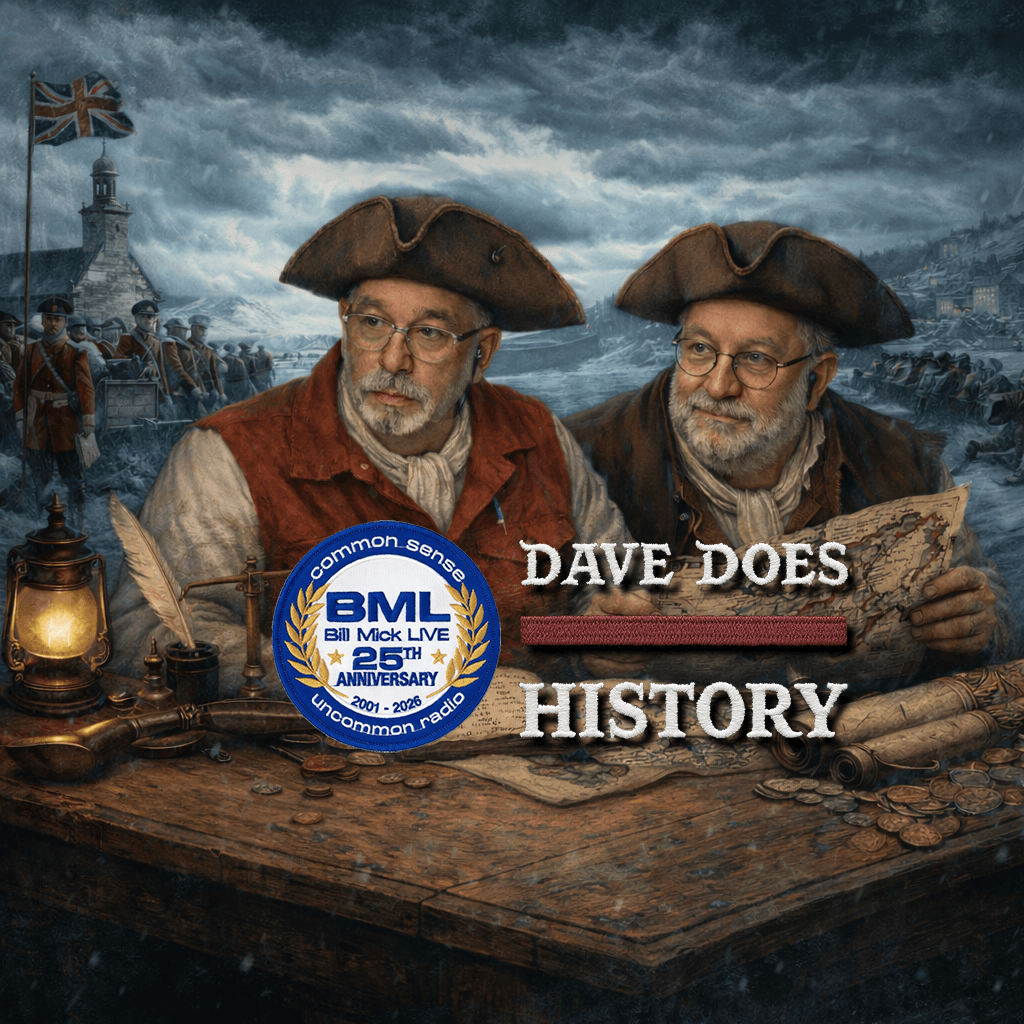
What happens when a sixteen-year-old apprentice hurls an insult, a British sentry swings back, and the streets of Boston are already boiling with resentment? You get one of the most pivotal—and misunderstood—moments in American history: the Boston Massacre.

In this week’s episode of Dave Does History on Bill Mick Live, we dig into how a seemingly small confrontation snowballed—literally—into a deadly street clash that would help define the path to American independence. And no, this wasn’t just “a riot.” Nor was it some random act of chaos. It was a collision of grievances, politics, and propaganda, years in the making.
The Sons of Liberty, fed up with Parliament’s taxes and heavy hand, weren’t exactly playing nice. They were savvy, organized, and not above using theater to stir colonial anger. When twelve-year-old Christopher Seider was killed in February 1770, his funeral became a spectacle of resistance—2,000 Bostonians in mourning, church bells tolling, and Sam Adams seizing the narrative.
Just two weeks later, snowballs and insults outside the Customs House turned to gunfire. Five civilians were dead. The British called it a riot. Boston called it a massacre. And Paul Revere—never one to let facts get in the way of good propaganda—engraved an image that would burn itself into the American conscience.
But here’s where the story takes a turn too few modern Americans appreciate.
Enter John Adams.
No mob leader, no torch-bearer—just a principled lawyer who saw through the noise and said, “We are a nation of laws, not passions.” Adams took up the defense of the British soldiers, knowing full well it could cost him everything. Why? Because he believed the future Republic must be built on justice, not vengeance.
In this episode, we unpack the trials, the juries (yes, there were two), and the aftermath—where two soldiers were branded for manslaughter, and six were acquitted. It wasn’t clean. It wasn’t easy. But it was necessary. And it helped lay the foundation for something far bigger than a verdict: a new American identity rooted in liberty and the rule of law.
So join us as we trace the blood in the snow to the ink on the Declaration. Because sometimes revolutions don’t begin with a shot heard round the world. Sometimes, they start with a snowball on a cold March night.


 DAVE DOES HISTORY
Leave a comment