
Before there was freedom of religion in America, before Thomas Jefferson penned the Virginia Statute, before James Madison hammered out the First Amendment, there was a moment in 1688 when England, ever so cautiously, took a step toward religious tolerance. The Toleration Act of 1688, often referenced by its date of royal assent in 1689, was not a dramatic leap into liberty. It was more like loosening a stiff collar after a long and tense dinner. Yet even this modest breath of fresh air stirred ideas that would cross the Atlantic and take root in American soil.
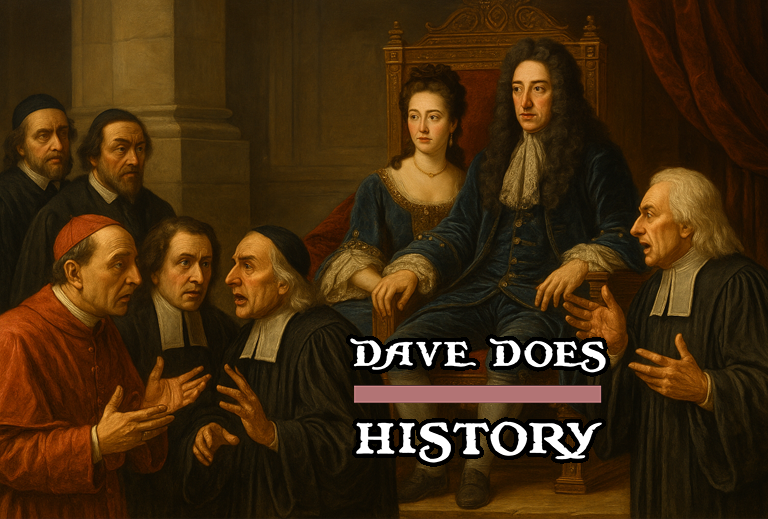
The backdrop to this law was nothing short of political and religious chaos. England had just undergone what became known as the Glorious Revolution, a relatively bloodless shift in power that removed the Catholic King James II from the throne. In his place, Parliament invited his Protestant daughter Mary and her Dutch husband William of Orange to rule jointly. The English were exhausted by religious tyranny and deeply fearful of Catholic absolutism. They saw James’s removal as a way to protect Protestantism and ensure political stability. But even within Protestantism, there was division. The Church of England had long enforced religious conformity through a battery of laws that punished dissenters. These were Protestants who refused to embrace the doctrine, liturgy, or structure of the Anglican Church. They included Presbyterians, Baptists, Congregationalists, and Quakers.
William and Mary owed their throne to a coalition of political factions. Both Whigs and Tories had promised religious relief to these dissenters, and the crown was expected to deliver. William himself was a Dutch Calvinist and understood the power of religious moderation. The result was the Toleration Act. It was not a radical departure. It was a compromise, carefully worded to calm tensions while maintaining the authority of the Church of England.
The Act granted legal protections to Protestant dissenters. These groups could now worship openly, but only under strict conditions. They had to take oaths of allegiance to the monarch. They had to subscribe to a declaration of belief in the Trinity. Their places of worship had to be licensed. Their ministers had to be approved. Worship could not take place secretly. In fact, churches were required to keep their doors unlocked during services to prevent any suspicion of plotting or sedition.
This newfound toleration came with clear limits. Roman Catholics were excluded entirely. So were Jews, atheists, and Unitarians. Anyone who denied the Trinity found no shelter under this law. The Act also preserved many of the civil restrictions on dissenters. They still could not attend Oxford or Cambridge. They could not hold public offices. They could not participate fully in civic life. They were allowed to breathe, but only in a narrow space.
Despite its shortcomings, the Toleration Act was a milestone. It marked the end of open persecution for many Protestants. No longer would Baptists and Quakers be fined or jailed simply for worshipping in their own way. They were still second-class citizens, but now they had a legal foothold. As John Locke wrote at the time, it was not as broad as many had hoped, but it was progress. Locke’s own writings on toleration had laid much of the philosophical groundwork for the Act. He argued that faith could not be coerced, and that religious liberty was essential to a stable society.
In England, the Act had a slow but steady effect. By 1710, over 2,500 dissenting congregations had registered with the government. These churches formed the basis of a vibrant religious culture outside the established church. Still, they remained subject to social and legal limitations for more than a century. The Anglican Church continued to dominate education and government. The Test Acts, which barred dissenters and Catholics from public service, remained in place until well into the 1800s.
Across the Atlantic, the situation was more complex. The American colonies had been charting their own religious paths for decades. Places like Rhode Island and Pennsylvania had already embraced broad religious liberty. Other colonies, like Virginia and Massachusetts, maintained established churches. In those colonies, the Toleration Act’s reach was less clear. Some colonial leaders resisted its authority. Others used it selectively.
Virginia offers a revealing case. In 1699, the colony passed a law acknowledging the Toleration Act and exempting certain dissenters from penalties for skipping Anglican services. But the law imposed requirements. Dissenters had to register with the county court. They had to attend services in officially licensed meetinghouses. Their ministers had to be approved by the General Court in Williamsburg. It was toleration, but it came with strings attached.
Things became more heated during the Great Awakening of the mid-eighteenth century. This religious revival brought new energy to non-Anglican groups. Evangelical Baptists and Presbyterians began preaching in the Virginia backcountry. Many refused to seek licenses. They saw the requirement as an insult to the gospel. Samuel Davies, a prominent Presbyterian preacher, challenged the authorities directly. In 1752, he wrote to the Bishop of London asking whether the Act of Toleration did not apply equally to colonists. The British attorney general eventually agreed that it did.
That ruling did not put an end to religious persecution. Baptist ministers were still jailed for preaching without licenses. Dissenters were still required to pay taxes to support the Anglican Church. Evangelicals who believed in itinerant preaching often ran afoul of laws designed to restrict them. Yet the resistance to these restrictions began to take on a new tone. Colonial preachers and their congregations began to speak in terms not only of toleration, but of freedom.
By the time of the American Revolution, the concept of religious liberty had expanded far beyond the framework of the 1688 Act. In 1776, Virginia’s Declaration of Rights proclaimed that religion was a matter of reason and conscience, not force. A decade later, Jefferson’s Virginia Statute for Religious Freedom went further. It declared that no man should be compelled to support any religious worship and that all should be free to follow their convictions. That statute, championed by James Madison, became a model for the First Amendment of the United States Constitution.
What began as a carefully worded compromise in the English Parliament ended up sparking a profound transformation. The Toleration Act did not achieve full liberty. It excluded too many. It protected too few. It upheld a system that favored one church over all others. Yet it cracked the door open. It acknowledged, however reluctantly, that the state could survive without enforcing religious conformity.
That small crack widened over time. In England, it led eventually to broader legal rights for dissenters, Jews, Catholics, and others. In America, it helped lay the intellectual groundwork for complete religious freedom. The Act taught people that coexistence was possible. That belief was a seed. In the revolutionary soil of the New World, it took root and grew into something far more powerful.
Toleration is not the same thing as liberty. It suggests a kind of grudging permission. But for the Protestant dissenters of 1688, it was a lifeline. And for the generations that followed, it became a steppingstone to something greater. The Toleration Act may have been born of political necessity. But in its limited mercy, it helped launch a much wider movement toward the freedom of conscience. That idea, once planted, could not be uprooted.

 DAVE DOES HISTORY
Leave a comment