
It began with a piece of parchment and a declaration. On May 17, 1756, the Kingdom of Great Britain formally declared war on the Kingdom of France. For anyone watching the slow-burning tensions of the past decade, it was hardly a surprise. But the significance of that declaration cannot be overstated. In that moment, what had been a series of regional conflicts transformed into a single, globe-spanning firestorm: the Seven Years’ War.
Many historians have called it the first “world war,” and for good reason. Its battles raged in the forests of North America, the coastal jungles of India, the icy Baltic, and the sugar-rich Caribbean. It drew in nearly every major European power and shook every continent except Antarctica. For Britain, it became the crucible that forged the First Empire. For France, it marked the beginning of a long and painful decline. And for the world, it was a prelude to the revolutionary century that followed.
The embers had been smoldering since the War of the Austrian Succession ended in 1748. That conflict had settled little. Austria still smarted from the loss of Silesia to Frederick the Great’s Prussia. France and Britain, supposedly at peace, watched each other warily across the oceans, each staking claim to overlapping colonial ambitions in India and North America. The Treaty of Aix-la-Chapelle had stopped the gunfire, but not the ambition.
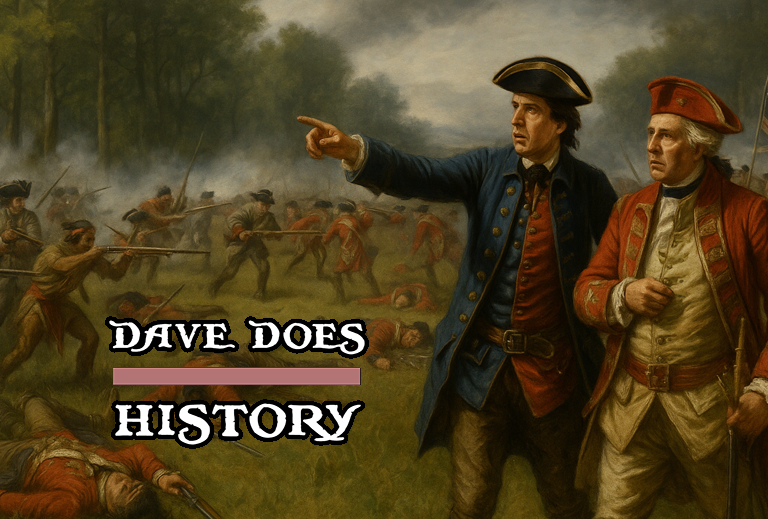
In the Ohio River Valley, France constructed a chain of forts to solidify its claim and push back British encroachment. British colonists in Virginia and Pennsylvania viewed this as provocation. In 1754, a young George Washington led a surprise attack against a French detachment at Jumonville Glen. The French response was swift. Washington’s small force was surrounded and defeated at Fort Necessity that July. These skirmishes ignited what became known in North America as the French and Indian War—two years before formal declarations of war arrived in Europe.
By 1755, the British had begun seizing French ships and even captured French troop transports, despite no official state of war. Tensions snapped with Britain’s formal declaration on May 17, 1756. But by then, Europe was already rearranging its alliances in what historians call the Diplomatic Revolution.
France and Austria—long-standing rivals—became allies. Meanwhile, Britain aligned itself with its former adversary Prussia. The realignment shocked traditionalists but was driven by cold calculation. Maria Theresa of Austria remained obsessed with recovering Silesia. King George II of Britain, equally obsessed with defending his German possession of Hanover, viewed a French attack as imminent. For France, an alliance with Austria offered the chance to undermine both Britain and Prussia.
That summer, Frederick the Great acted before his enemies could. On August 29, 1756, Prussian forces invaded Saxony. The Saxon army retreated to Pirna and was soon surrounded. On October 1, at the Battle of Lobositz, Frederick defeated an Austrian force attempting to relieve them. Saxony surrendered, and its troops were absorbed into the Prussian ranks. War had begun in earnest.
Britain’s declaration was more than symbolic. It signaled the unleashing of global imperial power. The Royal Navy surged into action, blockading ports and striking across oceans. In India, Lieutenant-Colonel Robert Clive launched the campaign that would culminate in his victory at Plassey in 1757. There, with only 3,200 men, he routed a vastly larger force under the Nawab of Bengal. The conquest secured Britain’s dominance in the region and began the slow dismantling of French influence in India.
In North America, British forces learned from early mistakes. After General Braddock’s disastrous 1755 campaign—where his army was ambushed and routed—British commanders began incorporating light companies into regiments. These troops were trained for scouting, skirmishing, and better maneuvering in the woods. Their adaptation was key in turning the tide.
By 1759, a critical year known as the “Annus Mirabilis,” British forces achieved a series of major victories. In Canada, General James Wolfe led a daring nighttime ascent of the cliffs outside Quebec. On the morning of September 13, Wolfe faced French commander Montcalm on the Plains of Abraham. Both men were mortally wounded, but the British held the field. Quebec fell. The French position in Canada unraveled.
In the Caribbean, British land and naval forces seized the valuable French island of Guadeloupe in 1759, followed by Martinique in 1762. These were not just tropical prizes—they were engines of European wealth, producing sugar, rum, and tobacco.
Meanwhile, Frederick the Great, surrounded by enemies, managed to hold his own against staggering odds. Victories at Rossbach (1757) and Leuthen (1757) confirmed his military brilliance. Even defeats, like Kunersdorf (1759), failed to crush him. Against Austria, Russia, Sweden, and France, Prussia endured. By war’s end, its survival had transformed it from a regional player to a recognized great power.
The Treaty of Paris in 1763 formally ended hostilities. France ceded all of Canada and its territories east of the Mississippi to Britain. Louisiana was handed to Spain. Britain gained control of India’s key coastal enclaves and several valuable Caribbean islands. Spain, who had entered the war in 1762, ceded Florida to Britain but received Havana and Manila in return. The result was a globe where British influence had dramatically expanded.
But the cost was immense. The death toll was in the hundreds of thousands across the major belligerents. The war plunged France deep into debt, feeding the grievances that would explode in the French Revolution. Britain’s new empire required revenue to maintain, prompting taxes on American colonists and sowing the seeds of revolt. In Prussia, the war confirmed Frederick as one of Europe’s most formidable rulers, reshaping the map of Central Europe and setting the stage for future conflicts over German unification.
What began with a formal declaration on May 17, 1756, became a storm that remade the world. It was not just a European squabble over succession or territory—it was a global confrontation over empire, influence, and survival. It taught nations to think globally, to fight across oceans, and to build alliances not of tradition, but of necessity.
May 17 was the day the Seven Years’ War officially began. But more than that, it was the day the modern world began to take shape, forged in fire, tested on the battlefield, and sealed with signatures in ink.


 DAVE DOES HISTORY
Leave a comment