
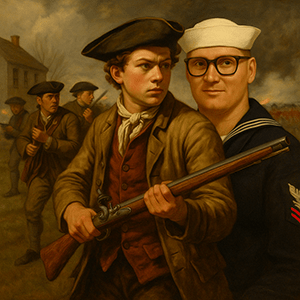
In the quiet hours before dawn on April 19, 1775, the people of Lexington, Massachusetts, were not sleeping soundly. Word had spread like wildfire across the countryside: British regulars were marching from Boston. Their destination was Concord, where colonial militias had stored arms and ammunition. But to get there, they would have to pass through Lexington, a town that had already earned a reputation for patriot defiance. Among those who rose from bed that morning, strapped on his powder horn, and took his place on Lexington Green was a seventeen-year-old named Ebenezer Bowman.
Listen to the article:
Ebenezer was not the youngest that morning, but close to it. He stood with more than seventy others under the command of Captain John Parker, a man of modest health but steady conviction. They were not trained soldiers, these men. They were farmers, blacksmiths, fathers, sons. They had muskets, yes, but little expectation of using them. Parker’s orders were clear: stand your ground, do not fire unless fired upon. The goal was not to provoke but to send a message. The British were not welcome here.
As the first slivers of sunlight stretched across the dew-covered grass, glints of steel began to shimmer in the distance. Bayonets. Hundreds of them. The British column, about 700 strong, approached in disciplined formation. The moment was thick with silence and dread. According to eyewitness accounts, including a deposition signed by Ebenezer Bowman himself just six days later, the British fired first. Eight Americans fell. Several more were wounded. Chaos erupted. Some of the militia returned fire, others fled, but none forgot. The opening exchange on Lexington Green lasted mere minutes, but it marked the beginning of a war that would reshape the world.
That moment—the shot heard round the world—was not fired in glory or triumph. It came in confusion and tragedy. It did not come with the booming declaration of independence or the grand parade of liberty. It came with smoke, screaming, and the crumpled bodies of neighbors. And yet, it was the turning point. The breach could no longer be patched. The time for speeches and petitions was over.
Ebenezer Bowman lived through it. He saw friends fall and a peaceful morning turned violent. But he did not simply return home and resume his life. Within a few weeks, he had enlisted. On May 15, 1775, he joined Captain Benjamin Locke’s Company in Lieutenant Colonel William Bond’s regiment. He was eighteen by then, just tall enough to be noticed, and just young enough to still carry the sharp edges of boyhood. He served through the Siege of Boston, earning five pounds for his efforts—a modest sum for a young man whose family, like many in Lexington, had long lived close to the land and the rhythms of toil.
Ebenezer’s service did not end with the fall of Boston. He remained involved, serving in other Massachusetts regiments. He would later participate in the political life of the new nation, playing a role in Pennsylvania’s ratification of the Constitution. In this way, his life reflects the arc of the Revolution itself: from musket fire to nation-building. From resistance to responsibility.
The Battle of Lexington, though brief, became an icon of American defiance. It confirmed what many suspected—that reconciliation with the British Crown was slipping out of reach. It galvanized resistance across the colonies. Within days, thousands of militia from across New England descended upon Boston, laying siege to the city. The British, once so confident in their control, found themselves hemmed in by farmers with guns and a cause.
General Thomas Gage, the royal governor and commander of British forces in North America, had underestimated the resolve of the colonists. He had hoped a swift show of force might cow the militias, seize their supplies, and send the rabble home. Instead, he triggered a war. Gage’s own position became untenable. By the summer, he would be recalled to Britain, his reputation in tatters.
The colonists, for their part, had no illusions about the cost of what they had begun. Men like Ebenezer Bowman knew they were not marching into a short dispute but a long struggle. They were not fighting for revenge, but for the principle that free men ought to govern themselves. The events of that day would be debated, romanticized, and immortalized in poems and paintings, but to those who lived it, it was not mythology. It was memory.
Ralph Waldo Emerson would later capture the spirit of the moment in his poem, Concord Hymn: “Here once the embattled farmers stood, and fired the shot heard round the world.” He referred to the engagement at the North Bridge in Concord, but the spirit of his words rings true for Lexington as well. It was on Lexington Green that the war truly began. And it was men like Ebenezer Bowman who carried it forward.
The legacy of Lexington is not merely in the battle statistics or the musket smoke. It lies in the willingness of ordinary people to stand in defense of principle. It lies in the story of a teenage boy who bore witness to a nation’s birth pangs and chose to keep fighting. And it echoes still in our modern debates about liberty, government, and the responsibilities of citizenship.
There is something profoundly American about Ebenezer Bowman’s story. He was not a general. He was not a signer of the Declaration. He did not wear medals or seek monuments. He was a witness to history and an actor in its unfolding. And when the time came to choose between safety and freedom, he chose freedom.
His legacy, and that of the Battle of Lexington, speaks directly to us today. We live in a time of noise and division, where principles often take a backseat to posturing. But Lexington reminds us that history turns not only on grand speeches and sweeping legislation, but on small decisions made by ordinary people. Decisions to stand. To resist. To say, not here, not now.
As the sun rose on that April morning in 1775, Ebenezer Bowman took his place with the others. He stood with courage, with clarity, and with a sense of duty to something larger than himself. That is a legacy worth remembering. That is a story worth telling.
We are, each of us, inheritors of that moment. Whether we trace our bloodline to the men on the green or not, we are citizens of the nation they helped to birth. We owe it to them—not in empty rhetoric or performative patriotism—but in honest engagement with the responsibilities of freedom. Because the shot heard round the world was not just the beginning of a war. It was the beginning of a promise. A promise that free people would govern themselves, protect their rights, and honor the sacrifices of those who stood before them.
So let us remember Ebenezer Bowman. Not because he was a hero in the Hollywood sense. But because he was real. He was there. And he chose to stand.
 DAVE DOES HISTORY
Leave a comment