
The Battle of Alexandria, fought on July 31, 30 BCE, marked a pivotal moment in Roman history. This conflict not only signified the end of a major civil war but also heralded the transition from the Roman Republic to the Roman Empire. The clash between Octavian and Mark Antony, culminating in Alexandria, was the last significant military engagement before the establishment of Augustus’ autocratic rule.
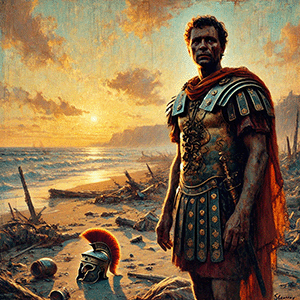
The late Roman Republic was characterized by political turmoil and power struggles. Following the assassination of Julius Caesar in 44 BCE, the power vacuum led to the formation of the Second Triumvirate, comprising Octavian, Mark Antony, and Lepidus. However, this alliance was short-lived, and the rivalry between Octavian and Antony intensified.
Antony, aligned with Cleopatra VII of Egypt, sought to consolidate his power in the East. This alliance was perceived as a direct threat by Octavian, who positioned himself as the defender of Rome’s traditional values against Antony’s alleged eastern decadence and ambitions.
Octavian, Julius Caesar’s adopted heir, was a shrewd politician and military strategist. He capitalized on Antony’s alliance with Cleopatra to portray himself as the savior of Rome, rallying support from the Senate and the Roman populace.
A formidable general and loyal ally of Julius Caesar, Antony’s military acumen was renowned. However, his personal and political alliance with Cleopatra alienated him from many in Rome, providing Octavian with the propaganda needed to turn the Senate and people against him.
The last active ruler of the Ptolemaic Kingdom of Egypt, Cleopatra was a skilled diplomat and strategist. Her relationship with Antony was both personal and political, intertwining the fates of Egypt and Antony’s Roman ambitions.
The forces involved were substantial. Octavian commanded a well-disciplined and loyal army, bolstered by his recent naval victory at Actium in 31 BCE. Antony and Cleopatra’s forces were significant but demoralized by previous defeats and internal dissent.
Octavian aimed to decisively eliminate Antony and Cleopatra to consolidate his power. His strategy involved both military action and psychological warfare, spreading propaganda to undermine Antony’s support.
Antony and Cleopatra, on the defensive, aimed to regroup and leverage Alexandria’s fortifications and their remaining naval strength. They hoped to outlast Octavian’s siege or find an opportunity for a counterattack.
The prelude to the battle saw Octavian’s forces advancing on Alexandria, securing strategic positions and cutting off supply lines. Antony’s attempts to rally his troops and break the siege were met with limited success.
On July 31, 30 BCE, the final confrontation took place. Octavian’s forces, disciplined and well-coordinated, launched a series of attacks that overwhelmed Antony’s defenses. Antony’s fleet, crucial to his defense strategy, was quickly neutralized. Desertions and defections further weakened Antony’s position, leading to a swift collapse of his forces.
Antony, realizing the battle was lost, attempted a final charge but was ultimately forced to retreat. Cleopatra, meanwhile, took refuge in her mausoleum, preparing for a last stand or negotiation.
The immediate aftermath saw the capture of Alexandria. Antony, facing inevitable defeat, committed suicide. Cleopatra, after failed attempts to negotiate with Octavian, also took her own life, famously using an asp.
With the deaths of Antony and Cleopatra, Octavian secured control over Egypt, annexing it as a Roman province. This victory eliminated the last significant opposition to his rule, allowing him to return to Rome as its undisputed leader.
The Battle of Alexandria was more than just a military victory; it marked the definitive end of the Roman Republic. Octavian, now Augustus, ushered in a new era of autocratic rule. The Senate, while still existent, lost much of its power and influence.
This transition had profound implications. The centralized power structure of the Empire brought stability but at the cost of the republican ideals of shared governance and civic freedom. Augustus’ reign laid the foundations for the Roman Empire’s future prosperity and expansion but also for the erosion of the political liberties that had defined the Republic.
The Battle of Alexandria stands as a turning point in Roman history. The defeat of Antony and Cleopatra not only secured Octavian’s power but also marked the end of the Roman Republic. The transition to the Empire reshaped the course of Western history, bringing about an era of unprecedented growth and stability under imperial rule. The legacy of this battle is a testament to the complexities of power, ambition, and the ever-evolving nature of political systems.




 DAVE DOES HISTORY
Leave a comment