
World War I, often referred to as the Great War, was a global conflict that reshaped the world order and had profound implications on the 20th century. Understanding the causes and the beginning of the war is crucial to comprehending its wide-reaching impact. The assassination of Archduke Franz Ferdinand, coupled with existing political tensions and alliances, led to the outbreak of World War I on July 28, 1914.
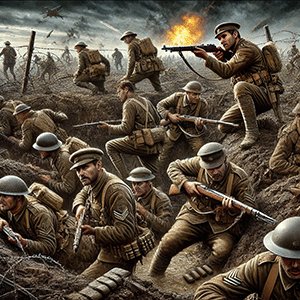
In the early 20th century, Europe was a powder keg of political alliances, nationalism, and militarism. The major powers were divided into two main alliances: the Triple Entente, consisting of France, Russia, and the United Kingdom, and the Triple Alliance, which included Germany, Austria-Hungary, and Italy. These alliances were meant to provide security but instead created a situation where a conflict involving one power could quickly draw in others.
Nationalism was rampant, with various ethnic groups seeking self-determination. This was particularly evident in the Balkans, where Slavic nationalists sought independence from Austro-Hungarian rule. Imperialism further exacerbated tensions, as European powers competed for colonies and resources worldwide.
Militarism played a significant role as well, with an arms race among the major powers. The belief in the inevitability of war led to massive military buildups and detailed war plans.
Archduke Franz Ferdinand was the heir presumptive to the Austro-Hungarian throne. The political situation in the Austro-Hungarian Empire was tense, with various ethnic groups, including Serbs, pushing for greater autonomy or independence. Serbia, in particular, was seen as a threat due to its support for Slavic nationalism.
On June 28, 1914, Archduke Franz Ferdinand and his wife, Sophie, were assassinated in Sarajevo by Gavrilo Princip, a Bosnian Serb and member of the Black Hand, a secret nationalist organization. The assassination was intended to protest Austro-Hungarian rule over Bosnia and Herzegovina, which had a significant Serb population.
The assassination sent shockwaves through Europe. Austria-Hungary, backed by Germany, issued an ultimatum to Serbia, demanding a series of harsh measures aimed at suppressing anti-Austrian activities. Serbia’s response was conciliatory but did not fully comply with all the demands. On July 28, 1914, Austria-Hungary declared war on Serbia, setting the stage for a larger conflict.
The delicate balance of power in Europe quickly unraveled. Serbia’s partial acceptance of the ultimatum was deemed insufficient by Austria-Hungary, which, encouraged by Germany’s “blank check” assurance of support, decided to take military action.
The intricate system of alliances came into play as nations mobilized in support of their allies. Russia, bound by its Slavic ties and its alliance with Serbia, began to mobilize its forces. Germany, in turn, declared war on Russia on August 1, 1914. France, allied with Russia, was drawn into the conflict against Germany and Austria-Hungary. When Germany invaded Belgium to outflank French defenses, Britain entered the war on August 4, 1914, citing the need to uphold Belgian neutrality.
The early stages of World War I saw significant battles and strategic maneuvers. The Battle of the Frontiers, a series of clashes along the Franco-German border, resulted in heavy casualties but no decisive outcome. Germany’s Schlieffen Plan, aimed at quickly defeating France by invading through Belgium, was met with fierce resistance, leading to a prolonged and bloody stalemate.
The war’s impact extended beyond Europe, drawing in colonies and nations from around the world. Troops from British, French, and German colonies fought on various fronts, making the conflict truly global. The war had devastating effects on civilian populations, leading to widespread suffering and economic disruption.
The outbreak of World War I on July 28, 1914, marked the beginning of one of the deadliest conflicts in human history. The complex interplay of political alliances, nationalism, militarism, and imperial ambitions created a volatile environment where a single assassination could ignite a global war. The lessons learned from this catastrophic event underscore the importance of diplomacy, international cooperation, and the pursuit of peace to prevent such conflicts in the future.
References
– Clark, C. (2012). *The Sleepwalkers: How Europe Went to War in 1914*. Harper.
– Fromkin, D. (2004). *Europe’s Last Summer: Who Started the Great War in 1914?* Knopf.
– Keegan, J. (1998). *The First World War*. Vintage.
– MacMillan, M. (2013). *The War That Ended Peace: The Road to 1914*. Random House.
– Tuchman, B. W. (1962). *The Guns of August*. Macmillan.


 DAVE DOES HISTORY
Leave a comment