
In 1997 I was able to visit the Holy Land and of course, we visited this particular Church. It was an interesting experiences, but one that sticks with me because it was such a clear example of the traditional location of sites of history being preserved through tradition and consecration.
The Church of the Holy Sepulcher stands as a beacon of Christianity, symbolizing faith, conflict, and perseverance. The Church was built in the 4th century by Emperor Constantine the Great, marks the site believed to be Golgotha, where Jesus was crucified, and the tomb where he was buried and resurrected. Constantine’s mother, Helena, is credited with identifying the site during her pilgrimage to Jerusalem.
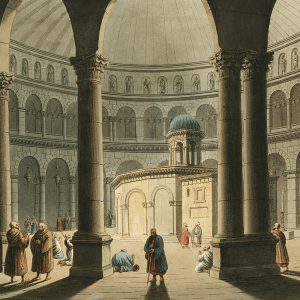
The church underwent several phases of construction, initially featuring a rotunda and a basilica. However, its history was fraught with turmoil. In 614, the Persians captured Jerusalem and damaged the church. Emperor Heraclius later restored it. The most devastating destruction came in 1009 when Fatimid Caliph al-Hakim ordered its demolition, leading to significant portions being reduced to rubble.
The First Crusade was initiated by Pope Urban II in 1095 with the goal of reclaiming Jerusalem from Muslim control and securing safe pilgrimage routes for Christians. The crusaders, driven by religious fervor and the promise of eternal salvation, embarked on a perilous journey.
The siege of Jerusalem began in June 1099. Key figures, such as Godfrey of Bouillon and Raymond IV of Toulouse, led the crusader forces. The siege was brutal, with intense fighting and significant casualties on both sides. On July 15, 1099, the crusaders breached Jerusalem’s defenses and captured the city.
The capture of the Church of the Holy Sepulcher was both a strategic and symbolic victory. For the crusaders, it represented the reclaiming of Christianity’s most sacred site. The immediate aftermath saw widespread massacres of Jerusalem’s Muslim and Jewish inhabitants, staining the victory with blood.
Following the capture, the church underwent significant reconstruction efforts. The crusader states, with contributions from various leaders and patrons, embarked on rebuilding the church to restore its former glory.
The dedication ceremony in 1149 marked the 50th anniversary of the capture of Jerusalem. This event was attended by key figures from the crusader states and the Christian world. The rebuilt church featured a blend of Romanesque and Byzantine architectural styles, with new additions enhancing its grandeur.
The history of the Church of the Holy Sepulcher since 1149 has been marked by changes in control and influence. The church changed hands multiple times, reflecting the shifting political and religious landscape of Jerusalem. Despite these changes, it remained a focal point of Christian worship and pilgrimage.
Architectural and structural changes continued over the centuries, driven by the need for restoration after natural disasters and conflicts. Notable renovations included repairs after earthquakes and the addition of new chapels and altars by various Christian denominations.
In the modern era, the Church of the Holy Sepulcher stands as a symbol of inter-denominational cooperation. Efforts to preserve and maintain the church have been undertaken by the Greek Orthodox, Armenian Apostolic, Roman Catholic, Coptic Orthodox, Ethiopian Orthodox, and Syriac Orthodox communities.
The Church of the Holy Sepulcher’s historical journey reflects its enduring significance to Christianity and its role as a symbol of faith and conflict. The legacy of the Crusades, intertwined with the church’s history, continues to influence Christian-Muslim relations. Today, the Church of the Holy Sepulcher remains a testament to the resilience of faith and the enduring quest for spiritual connection.




 DAVE DOES HISTORY
Leave a comment