
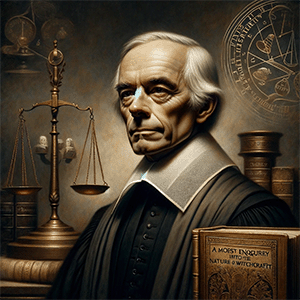
 John Hale was born on June 3, 1636, in Charlestown, Massachusetts Bay Colony. He grew up in a Puritan family during a time when the Massachusetts Bay Colony was still in its early years, struggling to establish a society based on their religious ideals. His early life was steeped in the Puritan tradition, with a strong emphasis on religious education and community values. Hale graduated from Harvard College in 1657, demonstrating his commitment to religious and academic excellence. His education and upbringing prepared him for a life dedicated to the ministry and the strict moral code of Puritanism.
In 1664, John Hale became the pastor of the First Church in Beverly, Massachusetts. As a Puritan pastor, Hale was a central figure in the community, responsible for the spiritual well-being of his congregation. He was known for his devout faith and adherence to Puritan doctrines, which emphasized the sovereignty of God, the importance of scripture, and the need for personal piety and moral discipline. Hale’s sermons and leadership helped shape the religious life of Beverly, reinforcing the strict moral and religious framework of Puritan society.
When the Salem Witch Trials began in 1692, Hale initially supported the trials. As a respected minister, he believed in the reality of witchcraft and the need to eradicate it from the community to maintain spiritual purity. He participated in the examinations and trials, convinced that the accusations and confessions were genuine evidence of witchcraft. Hale’s involvement lent credibility to the proceedings and influenced public opinion in favor of the trials.
However, Hale’s perspective began to shift as the trials progressed and the number of accusations increased. The turning point for Hale came with the arrest and execution of Rebecca Nurse, a pious and respected member of the community. Hale began to see the flaws and injustices in the proceedings, particularly the reliance on spectral evidence and the confessions extracted under duress. The sheer number of accusations and the targeting of individuals previously considered devout and upright raised doubts in Hale’s mind about the legitimacy of the trials.
In 1702, Hale published his book, “A Modest Enquiry into the Nature of Witchcraft,” in which he expressed his changed views on the Salem Witch Trials. In this work, Hale sought to understand the nature of witchcraft and the reasons behind the hysteria that had gripped Salem. He argued that while witchcraft was real, the trials had been mishandled, leading to wrongful convictions and executions. Hale proposed that the Devil had exploited the fears and superstitions of the community to sow discord and destruction. He emphasized the importance of due process, evidence, and caution in dealing with accusations of witchcraft.
John Hale’s legacy is a complex one, marked by his initial support for the Salem Witch Trials and his later efforts to correct the injustices that occurred. His book, “A Modest Enquiry into the Nature of Witchcraft,” is considered an important work in the history of the trials, offering a critical perspective from someone deeply involved in the events. Hale’s change of heart and his call for rationality and justice in dealing with witchcraft accusations highlight the dangers of mass hysteria and the importance of due process. Today, Hale is remembered as a figure who, despite his early mistakes, sought to understand and rectify the wrongs of the past.
In his book, “A Modest Enquiry into the Nature of Witchcraft,” John Hale provides a detailed examination of the Salem Witch Trials and the phenomenon of witchcraft. He begins by affirming the reality of witchcraft and the Devil’s influence but criticizes the trials for their reliance on spectral evidence and forced confessions. Hale argues that the Devil used the trials to create chaos and distrust within the community. He calls for a more cautious and evidence-based approach to accusations of witchcraft, emphasizing the need for justice and due process. Hale’s work serves as both a critique of the trials and a reflection on the broader issues of fear, superstition, and the dangers of unchecked authority.

 DAVE DOES HISTORY
Leave a comment