
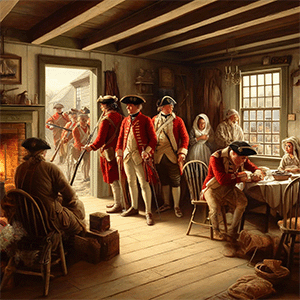
 The Quartering Act of 1774, part of the series of punitive measures known as the Intolerable Acts, was enacted by the British Parliament on June 2, 1774. This legislation sought to address the housing needs of British soldiers stationed in the American colonies. However, the roots of the Quartering Act can be traced back to its predecessor, the Quartering Act of 1765.
The Quartering Act of 1765 required colonial assemblies to provide housing, food, and supplies for British troops. This could include accommodations in inns, alehouses, and unoccupied buildings. The Act aimed to support the British army in maintaining order and protecting colonial interests, especially after the French and Indian War.
Quartering, the practice of housing soldiers among the civilian population, was not a novel concept. Historically, armies required accommodations and supplies, often provided by local populations. In the American colonies, the need for quartering increased due to the presence of British troops deployed to enforce colonial policies and protect against external threats.
However, the American colonists viewed quartering with increasing resentment. The practice represented a significant intrusion into their lives and property. Colonists were compelled to house soldiers in their homes, sometimes against their will, and at their expense. This encroachment on personal property and autonomy fueled growing discontent.
The American colonists’ opposition to quartering was rooted in several key grievances:
1. Invasion of Privacy: Colonists saw quartering as a violation of their privacy and personal space. The presence of soldiers in their homes disrupted daily life and created tensions.
2. Financial Burden: Providing for soldiers imposed a financial strain on households, as they had to bear the costs of food, supplies, and lodging.
3. Political Resistance: Many colonists viewed quartering as a tool of oppression, a way for the British government to assert control and suppress dissent. The presence of troops was seen as a means to enforce unpopular laws and taxes.
The Quartering Act of 1774 intensified colonial opposition. Unlike the 1765 Act, which primarily targeted public houses and unoccupied buildings, the 1774 Act allowed for the quartering of soldiers in private homes if necessary. This expansion of authority was perceived as a direct assault on personal liberty and property rights.
Colonial reactions were swift and vehement. The Act was one of the key elements of the Intolerable Acts, which also included the Boston Port Act, the Massachusetts Government Act, and the Administration of Justice Act. These measures were designed to punish Massachusetts for the Boston Tea Party and to reassert British control.
The Quartering Act of 1774 galvanized colonial resistance, leading to greater unity among the colonies. It was one of the catalysts for the First Continental Congress, where delegates from twelve of the thirteen colonies gathered to coordinate their response to British policies. The Congress ultimately called for a boycott of British goods and petitioned King George III for redress of grievances.
The legacy of the Quartering Act is evident in the United States Constitution, particularly in the Third Amendment, which states: “No Soldier shall, in time of peace be quartered in any house, without the consent of the Owner, nor in time of war, but in a manner to be prescribed by law.” This amendment reflects the colonists’ deep-seated aversion to the practice of quartering and their desire to protect individual rights and property.
Today, the Third Amendment is rarely invoked, as the circumstances that led to its creation are largely historical. However, it remains a testament to the importance of personal privacy and property rights in American law. The amendment serves as a reminder of the abuses that can occur when government power is unchecked and the need to safeguard individual freedoms.
The Quartering Act of 1774 was a significant factor in the escalating tensions between the American colonies and the British government. The practice of quartering, seen as an infringement on personal liberty and property, fueled colonial resistance and contributed to the outbreak of the American Revolution. Its enduring legacy is enshrined in the Third Amendment, underscoring the importance of protecting individual rights from government overreach.

 DAVE DOES HISTORY
Leave a comment