
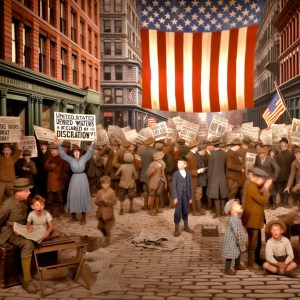
 On April 6, 1917, the United States Congress made a momentous decision that would forever alter the course of American history. By declaring war on Imperial Germany, the United States ended its stance of neutrality and joined the allies in World War I. This decision was not reached lightly and came after intense debate and division within both Congress and the wider American public.
The vote to declare war was a culmination of escalating tensions between the United States and Germany, particularly over unrestricted submarine warfare, which had resulted in the loss of American lives and property. Despite President Woodrow Wilson’s re-election in 1916 under the slogan “He kept us out of war,” the sinking of American ships by German U-boats and the revelation of the Zimmermann Telegram, in which Germany proposed a military alliance with Mexico against the United States, shifted the tide of public opinion and political will towards intervention.
The vote in Congress was tense and fraught with emotion. In the Senate, the resolution passed with a significant majority of 82 to 6. The House of Representatives followed suit, albeit with a closer margin, approving the declaration by a vote of 373 to 50. The division in the vote reflected the deep-seated debates and concerns among lawmakers about the implications of entering a global conflict.
 The opposition to the declaration of war was varied and vocal, encompassing a broad spectrum of political and social groups. Prominent among the opponents were the pacifists, who opposed all forms of military conflict on moral grounds, and the isolationists, who believed that America should stay out of European affairs. Additionally, certain ethnic groups with strong ties to Germany and other Central Powers advocated for neutrality, fearing the consequences of America entering the war on the side of the Allies.
Notably, Jeanette Rankin of Montana, the first woman ever elected to Congress, cast a vote against the declaration, reflecting her pacifist beliefs. Her vote was emblematic of the broader anti-war sentiment that existed within parts of American society.
The general reaction to the news of the war declaration was mixed. In many cities, there were patriotic rallies and parades supporting the decision, with citizens coming together to show their support for American troops and the Allied cause. The wave of patriotism was further fueled by government propaganda campaigns aimed at uniting the country and generating support for the war effort.
However, not all reactions were positive. In some communities, particularly those with strong immigrant populations from Central Powers nations, there was fear and anxiety about the implications of the United States entering the war. Additionally, the implementation of the draft, or Selective Service Act of 1917, led to widespread protests and, in some cases, riots against conscription.
The decision to declare war on Imperial Germany marked a pivotal moment in United States history, signaling the country’s emergence as a global power and its willingness to engage in international conflicts to defend its interests and principles. While the vote in Congress reflected a majority in favor of war, the opposition and diverse reactions across the country highlighted the complexities and divisions within American society at the time. The entry of the United States into World War I not only had a significant impact on the outcome of the conflict but also on the national identity and foreign policy direction of the nation for years to come.
There are a lot of things to discuss about World War I. It is what I consider to be the “Dumbest War in History.” There was literally no reason to fight it, no need to fight it, and no one, not one single person, ever stopped to think about the consequences of having it.
That said, it has created many an opportunity to reflect on war and its utter waste.
In 2008, a George Clooney film, Leatherheads, told the story (albeit highly fictionalized) of the early days of professional football in the United States. In the post WWI country, things were still very fluid in sports, but the uniting factor was how many players had become veterans. In a film that was fun and humorous, this film touched on the ideas of media influence and how war can change people (I also live the film “The Legend of Bagger Vance” for the same reasons).
But it is this scene – and literally the final 30 seconds of it, that still move me. I think that it reflects what the entire experience must have been – excitement, energetic and focused, followed by the realization that things aren’t what we expect them to be, followed by a sense of sadness, because “over there,” now has a new and much sadder meaning..

 DAVE DOES HISTORY
Leave a comment