
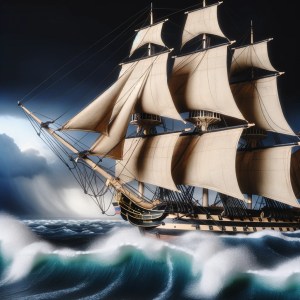
 On March 27, 1794, the United States Congress passed the Naval Act, marking a pivotal moment in American history—the establishment of the United States Navy. This decision was not merely an administrative act; it was a strategic move to protect American interests at sea and to establish the young nation’s presence on the global stage. The Act authorized the construction of six frigates, which would become the backbone of the early US Navy and symbolize America’s naval aspirations. This article delves into the purpose, design, service history, and enduring legacy of these six iconic vessels.
The establishment of a permanent navy was driven by pragmatic needs. American merchant ships, lacking naval protection, were prey to Barbary pirates and were caught in the crossfire of the naval skirmishes between Britain and France. The need for a capable naval force to protect American interests and assert the nation’s sovereignty on the high seas was clear. Thus, the Naval Act of 1794 was a declaration of the United States’ intent to defend its maritime trade and uphold its honor against foreign threats.
The primary purpose of these first six frigates—United States, Constellation, Constitution, Chesapeake, Congress, and President—was to defend American merchant vessels from piracy and to enhance the United States’ bargaining power on the international stage. These ships were built to be faster, more heavily armed, and more robust than their counterparts, making them formidable opponents in naval engagements.
The design of the first six frigates was revolutionary. Conceived by designers such as Joshua Humphreys, these ships were larger and more heavily armed than standard frigates of the time. They were constructed with live oak, renowned for its durability, and were designed to carry a formidable array of cannons. Their design allowed them to outgun ships of the same class and outrun larger ships-of-the-line, embodying the strategic doctrine of “commerce raiding” and blockade enforcement.
– Frigate United States: Launched in 1797, the United States was the first of the six to be completed. It achieved fame during the Quasi-War with France, capturing several French vessels, and later served with distinction in the War of 1812 against Britain, capturing HMS Macedonian.
– Frigate Constellation: Also launched in 1797, Constellation distinguished itself during the Quasi-War, capturing the French frigate L’Insurgente. It continued to serve in the Barbary Wars and the War of 1812, showcasing the American navy’s growing prowess.
– Frigate Constitution: Perhaps the most famous of the six, “Old Ironsides” was launched in 1797. It earned its nickname during the War of 1812, where its solid construction repelled British cannon fire. It saw action in numerous conflicts, including the Barbary Wars and the War of 1812, and remains a commissioned Navy vessel to this day.
– Frigate Chesapeake: Launched in 1799, Chesapeake’s career was marked by challenges, including a notable defeat by HMS Leopard in 1807. However, it also played a vital role in enforcing American maritime rights.
– Frigate Congress: Congress was launched in 1799 and served during the Quasi-War with France and the Barbary Wars. It was captured during the War of 1812 but had previously demonstrated the young navy’s capability and determination.
– Frigate President: Launched in 1800, President was active in the Quasi-War, the Barbary Wars, and the War of 1812. It was captured by the British in 1815, marking a valiant end to its service.
The legacy of the first six frigates extends beyond their individual exploits. Collectively, they signified the emergence of the United States as a maritime power and laid the foundation for a navy that would become instrumental in securing American interests and shaping international maritime law. Their construction was a testament to American ingenuity and a symbol of the nation’s resolve to protect its sovereignty and trade routes.
Moreover, the frigate Constitution continues to serve as a living museum, a floating embodiment of American naval heritage, and a testament to the enduring legacy of the first six frigates. These ships, their crews, and the values they represented played a crucial role in the establishment and evolution of the United States Navy, marking the beginning of a long and storied history of maritime excellence and national security.




 DAVE DOES HISTORY
Leave a comment