
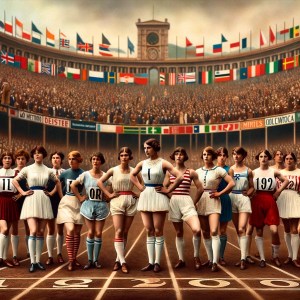
 The 1921 Women’s Olympiad, which opened on March 24, 1921, a landmark event in the history of women’s sports, marked the beginning of a new era, challenging traditional gender norms and setting the stage for the future inclusion of women in competitive athletics at the Olympic Games. This pioneering event not only showcased the athletic prowess of women but also played a crucial role in the fight for gender equality in sports.
The 1921 Women’s Olympiad was held in Monte Carlo, Monaco, and was organized by Alice Milliat and the Fédération Sportive Féminine Internationale (FSFI). This event came into being as a direct response to the International Olympic Committee’s (IOC) refusal to include women’s events in the 1924 Olympic Games. Alice Milliat, a prominent figure in women’s sports, advocated for the inclusion of women in the Olympics and sought to establish an alternative platform to demonstrate the capabilities of female athletes. The Women’s Olympiad was thus conceived as a pioneering effort to showcase women’s sports on an international stage.
The 1921 Women’s Olympiad saw the participation of women from several nations, including France, the United Kingdom, the United States, Switzerland, Italy, and Norway. This international representation highlighted the growing interest in women’s sports across the globe and underscored the universal appeal of athletic competition among women.
The event featured a variety of sports, demonstrating the diverse athletic talents of the participants. Among the sports included were track and field events such as the 60-meter dash, 4×110 yard relay, high jump, long jump, and shot put. These events were selected to showcase the physical strength, speed, and agility of the competitors, challenging existing stereotypes about women’s physical capabilities.
The 1921 Women’s Olympiad was a showcase of remarkable athletic achievements. Notable results included stellar performances in track and field events, with participants setting impressive records that stood as a testament to their skill and determination. The event not only highlighted the winners but also celebrated the spirit of participation and the collective effort to advance women’s sports.
The reception of the 1921 Women’s Olympiad was mixed. While it was celebrated by advocates of women’s sports as a significant step forward in the recognition of women’s athletic abilities, it also faced criticism and skepticism from those who doubted the appropriateness of women participating in competitive sports. Despite these challenges, the event succeeded in raising awareness about women’s sports and laid the groundwork for future advancements.
The legacy of the 1921 Women’s Olympiad is profound. It paved the way for the inclusion of women’s events in subsequent Olympic Games and contributed to the gradual acceptance of women in the world of competitive sports. The Women’s Olympiad also highlighted the importance of providing women with equal opportunities to participate in sports, contributing to the broader movement for gender equality. Alice Milliat’s efforts and the success of the event are remembered as pivotal moments in the history of women’s sports, inspiring future generations of female athletes to pursue their dreams without limitations.
The 1921 Women’s Olympiad stands as a monumental event in the history of sports, symbolizing the resilience and determination of women athletes to overcome barriers and claim their rightful place in the world of competitive athletics. Its legacy continues to inspire and influence the ongoing struggle for gender equality in sports and beyond.




 DAVE DOES HISTORY
Leave a comment