
The Newburgh Conspiracy was a pivotal moment in American history that unfolded against the backdrop of the Revolutionary War, bringing to light the simmering tensions between the Continental Army and Congress. It was during this critical juncture that General George Washington delivered a masterful speech, quelling potential mutiny and reinforcing the principles of democracy and civilian control over the military.
As the Revolutionary War drew to a close in 1783, the Continental Army, stationed in Newburgh, New York, grew increasingly frustrated with Congress. The soldiers were aggrieved by unpaid wages, lack of provisions, and the uncertain future of their pensions. Amidst these grievances, a faction within the army began to contemplate drastic measures to force Congress’s hand, including a potential coup. Suspected leaders of the conspiracy included Major John Armstrong, an aide to General Horatio Gates, though Gates’s involvement remains a topic of historical debate.
The root of the Newburgh Conspiracy lay in Congress’s inability to levy taxes directly and its reliance on states for voluntary financial contributions, which were often not forthcoming. This financial incapacity resulted in Congress’s failure to fulfill its promises to the Continental Army, exacerbating the soldiers’ discontent and setting the stage for the conspiracy.
In March 1783, an anonymous letter, later attributed to Major Armstrong, circulated among the officers, calling for a meeting to address their grievances and contemplate action against Congress. This call aimed to consolidate the frustration within the ranks into a unified demand for redress.
Initially, Washington was not scheduled to attend the meeting. However, recognizing the potential for disaster, he made a last-minute decision to participate, intending to diffuse the situation. His presence and authority were pivotal in transforming the course of the meeting.
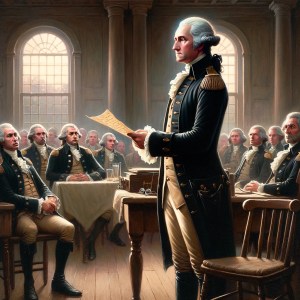 General Washington’s speech, delivered on March 15, 1783, is remembered not just for its eloquence but for its profound impact. While the exact words were not recorded verbatim, Washington appealed to the officers’ patriotism, urging patience and faith in Congress. He highlighted the dangers of their proposed actions, not just to their cause but to the very principles for which they had fought.
One of the most poignant moments came when Washington paused to put on his eyeglasses—a gesture that humanized the revered leader. He remarked, “Gentlemen, you must pardon me. I have grown gray in your service and now find myself growing blind.” This unexpected vulnerability touched his officers deeply, underscoring the shared sacrifices and strengthening his appeal for unity and patience.
Washington’s speech and demeanor quelled the brewing unrest, leading to a resolution expressing confidence in Congress and disavowing any thoughts of mutiny. The immediate threat of a military coup was averted, reinforcing the principle of civilian control over the military.
The Newburgh Conspiracy and Washington’s speech underscore the fragility of the young republic and the crucial role of leadership in navigating crises. Washington’s actions cemented his legacy as a leader committed to democratic principles and the rule of law. The event also highlighted the need for a stronger federal government, contributing to the discussions that eventually led to the Constitutional Convention in 1787.
The Newburgh Conspiracy remains a defining moment in American history, demonstrating the power of leadership, the importance of unity, and the enduring value of the principles upon which the United States was founded. Washington’s intervention not only averted a potential disaster but also laid the groundwork for the emerging nation’s commitment to civilian governance and the peaceful transfer of power.

 DAVE DOES HISTORY
Leave a comment