
Amerigo Vespucci, an Italian explorer whose name became synonymous with the New World, played a pivotal role in the age of exploration. His life story intertwines with the discovery and mapping of the Americas, leaving a legacy that would forever change the course of history.
Born on March 9, 1454, in Florence, Italy, Amerigo Vespucci was raised in a cultured environment that valued education and the arts. His early education was comprehensive, focusing on the humanities and sciences, which were flourishing during the Renaissance. Under the guidance of his uncle, a Dominican friar, Vespucci was introduced to the works of Ptolemy and the classical geographers, sparking his lifelong interest in geography and exploration.
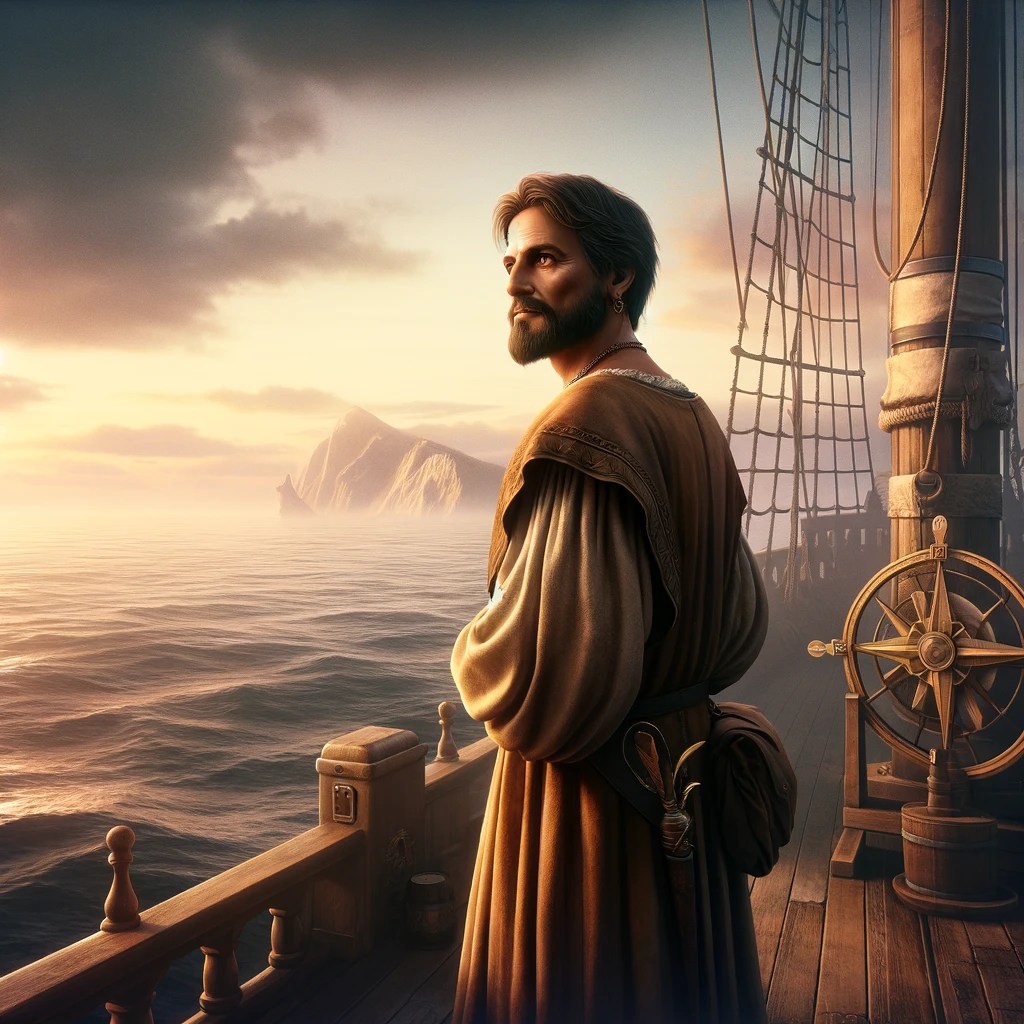
Before becoming an explorer, Vespucci embarked on a career as a diplomat and businessman. He was sent by the Medici family, the rulers of Florence, to Spain to look after their business interests. This role provided him with insights into the navigation techniques and the geographical theories of the time. Vespucci’s scientific curiosity led him to study astronomy and navigation, skills that would later prove invaluable in his voyages.
In 1492, Vespucci moved to Seville, Spain, a hub for maritime exploration following Christopher Columbus’s first voyage to the New World. In Seville, Vespucci worked for the Medici family business, outfitting ships for long voyages. This position allowed him to mingle with explorers and navigators, further deepening his knowledge and interest in exploration.
Vespucci’s first alleged voyage in 1497-1498 remains a subject of debate among historians. According to letters attributed to him, Vespucci claimed to have sailed westward, reaching the mainland of the New World before Columbus. However, the authenticity and accuracy of these claims have been questioned, and evidence supporting this voyage is scant.
In 1499, Vespucci joined an expedition led by Alonso de Ojeda to explore the coast of South America. This voyage marked Vespucci’s first confirmed participation in transatlantic exploration. The expedition explored parts of present-day Brazil and Venezuela, allowing Vespucci to observe the vastness and distinctiveness of the new lands, which he began to suspect were not part of Asia, as previously believed.
Vespucci’s most significant voyage took place between 1501 and 1502, under the Portuguese flag. This expedition explored the eastern coast of South America, further confirming Vespucci’s belief that these were indeed new continents separate from Asia. His observations during this voyage were crucial in understanding the true nature of the Americas.
There is also debate about a voyage in 1503-1504, during which Vespucci allegedly explored the coast of Brazil under Portuguese auspices. Details of this voyage are less clear, and like his first voyage, its historicity is debated among scholars.
After his explorations, Vespucci returned to Seville, where he was appointed as a navigation advisor and master of a new school for navigators. In this role, he contributed to the education of future explorers and the advancement of maritime navigation techniques.
Vespucci’s accounts of his voyages were widely published and read throughout Europe. Martin Waldseemüller, a German cartographer, was influenced by Vespucci’s descriptions of the New World. In 1507, Waldseemüller produced a world map that named the newly discovered continent “America” in Vespucci’s honor, mistakenly believing that Vespucci had discovered the continent before Columbus.
The publication of Vespucci’s letters, including the Mundus Novus, played a significant role in disseminating knowledge about the New World. These letters provided Europeans with some of the first insights into the geography, people, and wildlife of the Americas. However, the authenticity of some letters attributed to Vespucci has been questioned, contributing to the controversy surrounding his achievements.
The historicity of Vespucci’s voyages and contributions has been a topic of debate among historians. Some have questioned the accuracy of his accounts and whether he deserved the honor of having the Americas named after him. Despite these controversies, Vespucci’s role in the exploration of the New World and his contributions to navigation and geography are acknowledged.
Amerigo Vespucci died on February 22, 1512, in Seville, Spain. His legacy, however, endures in the name of the American continents. Vespucci’s life and voyages are a testament to the spirit of exploration and discovery




 DAVE DOES HISTORY
Leave a comment