
In the annals of French history, few events have been as pivotal and contentious as the execution of King Louis XVI. His reign, marked by a maelstrom of socio-political upheavals, culminated in a dramatic climax that forever altered the course of the nation. This article delves into the life of King Louis XVI, the tempestuous climate of France that led to his downfall, and the profound significance of his execution in the broader tapestry of the French Revolution.

Born on August 23, 1754, Louis-Auguste ascended to the French throne as Louis XVI in 1774, inheriting a kingdom burdened with economic distress and societal unrest. His reign began with a realm in financial disarray, largely due to costly involvement in foreign wars, including support for the American Revolution. Louis XVI, a monarch of a more introspective and less assertive demeanor than his forebears, faced the daunting task of navigating through the complexities of an evolving France.
Despite some initial efforts to reform and modernize the kingdom, including appointing ministers like Turgot and Necker, Louis XVI’s policies often faltered amid the entrenched interests of the nobility and the broader inertia of the ancien régime. His indecisiveness and perceived detachment from the common populace’s struggles only exacerbated the growing discontent.
The political landscape of France on the eve of the Revolution was a powder keg of tension and frustration. The social stratification of the time, with a privileged nobility and clergy juxtaposed against an increasingly burdened and politically voiceless Third Estate, set the stage for conflict. The economic hardships – exacerbated by poor harvests, rising bread prices, and an inequitable tax system – fueled the flames of discontent.
The convening of the Estates-General in 1789, intended as a means to address the financial crisis, inadvertently set the stage for a broader upheaval. The Third Estate’s transformation into the National Assembly marked the beginning of a revolutionary wave that sought not just fiscal reform but a complete overhaul of the social and political order.
The execution of King Louis XVI on January 21, 1793, was not just the demise of a monarch but a symbolic severance from the age-old institution of absolute monarchy. This act represented the radicalization of the Revolution, signaling a definitive shift from moderate reformist aspirations to a more profound and sweeping transformation of French society.
The king’s execution polarized opinions both within France and across Europe, igniting a myriad of reactions ranging from abhorrence and fear among monarchies to admiration and inspiration among those who yearned for republicanism. It marked the end of an era and the beginning of a new, albeit turbulent, chapter in the history of France.
The execution of King Louis XVI stands as a watershed moment in French history. It encapsulates the culmination of years of unrest, the breakdown of traditional structures, and the irrevocable shift towards a new societal order. The reverberations of this event were felt far beyond the borders of France, echoing through the annals of history as a potent symbol of the power of revolution and the end of divine-right monarchy.
The origins of King Louis XVI’s downfall can be traced to the dire financial straits that France found itself in during the late 18th century. Exacerbated by extravagant spending by the monarchy and costly military engagements, including the Seven Years’ War and the American Revolutionary War, the state coffers were depleted. The situation was worsened by poor harvests, leading to widespread famine and skyrocketing bread prices, which disproportionately affected the commoners.
In a desperate bid to address the financial crisis, Louis XVI convened the Estates-General in May 1789 for the first time in nearly 175 years. This assembly, comprising representatives from the three estates of French society – the clergy, the nobility, and the commoners (the Third Estate) – was intended to authorize tax reforms. However, it set the stage for a much more significant upheaval.
The Third Estate, representing a vast majority of the French population but often outvoted by the clergy and nobility, quickly grew disillusioned with the traditional format of the Estates-General. In a bold move, they declared themselves the National Assembly on June 17, 1789, asserting their intention to draft a constitution. This act marked a significant shift from seeking financial solutions to demanding political reform, laying the groundwork for the French Revolution.
Initially, Louis XVI’s response to these events was marked by indecision. However, as the revolutionary fervor intensified with events like the storming of the Bastille, the King’s attempts to reassert control only served to inflame the situation. His dismissal of popular ministers like Necker and his perceived collusion with foreign powers to undermine the Revolution further alienated him from the populace and the National Assembly.
The tipping point came with Louis XVI’s attempted escape from Paris to Varennes in June 1791. This failed flight was a disastrous miscalculation. It not only demonstrated his apparent lack of faith in the new constitutional order but also exposed his intentions to seek foreign intervention against the revolutionaries. The King’s flight severely damaged his credibility and legitimacy, leading many to question his commitment to the French people and the constitutional monarchy.
The path to the guillotine for King Louis XVI was a complex interplay of financial desperation, political upheaval, and personal misjudgments. His inability to navigate the swift currents of change and his missteps in the face of a nation clamoring for reform inexorably led to his downfall. The execution of Louis XVI was not merely the demise of an individual but the symbolic end of an ancient regime, marking a pivotal point in the history of France and the concept of modern governance.
In the wake of the escalating revolutionary fervor and the failed flight of the King, the political landscape in France underwent a drastic transformation. The National Convention, established in September 1792, succeeded the Legislative Assembly, and marked the first French government to abandon the monarchy in favor of a republic. This radical body, comprising various political factions including the Jacobins and the Girondins, was charged with the daunting task of steering France through its revolutionary turmoil.
The trial of Louis XVI was a landmark event in the history of the French Revolution, symbolizing the ultimate clash between the ancien régime and the new revolutionary order. The King faced several charges, most notably conspiring against the state and undermining the security of the nation. These accusations stemmed from a trove of discovered documents at the Tuileries Palace, which allegedly revealed Louis XVI’s clandestine efforts to undermine the revolution and restore his absolute power.
The trial of King Louis XVI commenced in December 1792 and was characterized by intense legal and political wrangling. The King, stripped of his regal titles and referred to as “Citizen Louis Capet,” was given limited means to defend himself. His defense focused on challenging the legality of the trial, asserting that as a monarch, he was subject only to God’s judgment, not that of the people. The proceedings were marked by fiery debates and were closely followed by a deeply divided French populace.
The decision regarding the King’s fate polarized the Convention. The Girondins, favoring a more moderate approach, generally argued for clemency or a referendum on the King’s fate, whereas the Jacobins, led by figures like Maximilien Robespierre, vehemently pushed for the death penalty. The debates were intense and philosophical, touching on issues of justice, the rule of law, and the very nature of the Revolution.
After a closely contested vote, the Convention found Louis XVI guilty of all charges. The decision on his punishment was even more fraught, with the final vote narrowly favoring execution over other forms of punishment. This verdict was a testament to the radicalization of the Revolution and the overwhelming desire among revolutionaries to permanently dismantle the monarchy.
The trial and conviction of King Louis XVI were not merely legal proceedings but a profound symbol of the seismic shifts in French society. His execution, decreed by the National Convention, marked the definitive end of the monarchy and a new era in French history, characterized by the principles of republicanism and a radical reimagining of political authority.
The morning of January 21, 1793 was gripped with a tense and heavy atmosphere. Paris, the epicenter of the Revolution, awoke to a city under tight security, as thousands of armed National Guards and revolutionary militia lined the streets. The air was cold, and the skies overcast, reflecting the somber mood of the city.
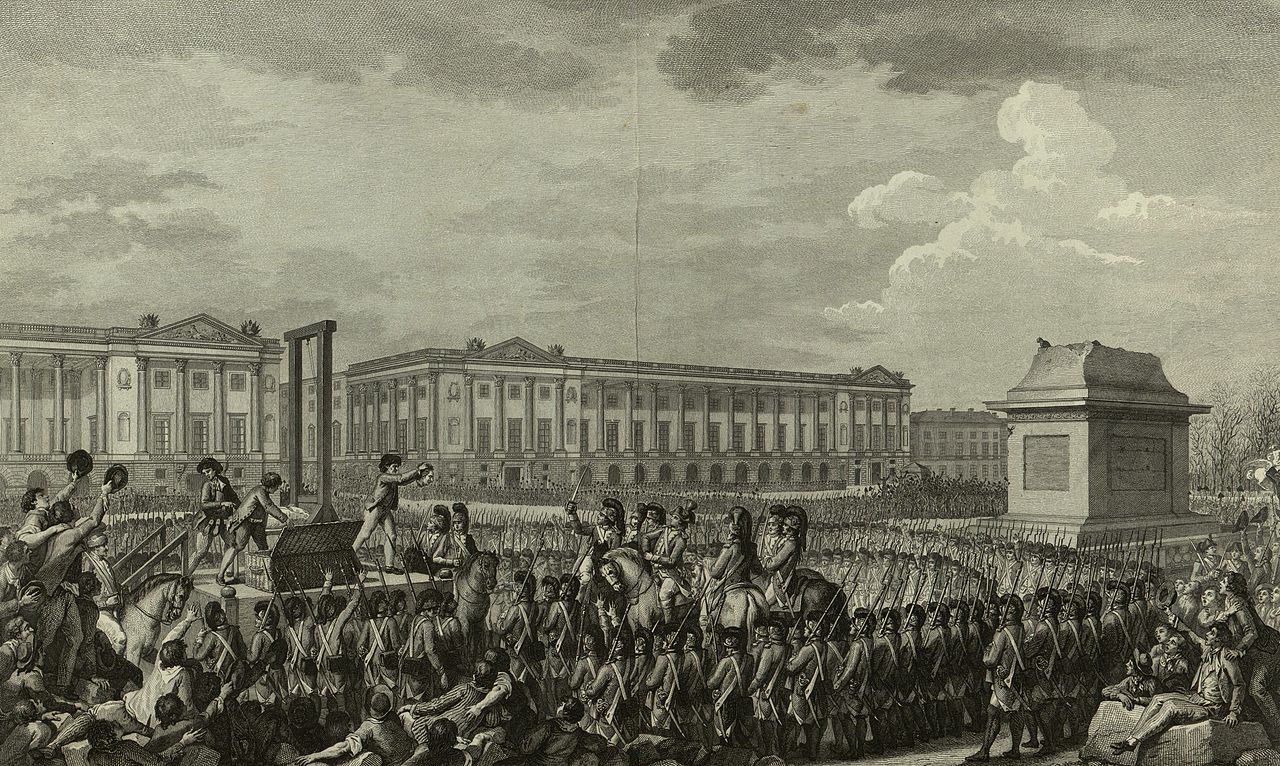
King Louis XVI, escorted by a heavy guard, was taken from the Temple prison to the Place de la Révolution, where the guillotine awaited. The journey was marked by an eerie silence, as the usual Parisian bustle gave way to a somber anticipation. The crowd, which had gathered in large numbers, was a mix of emotions, ranging from anger and vindication to sorrow and disbelief.
Upon arriving at the scaffold, Louis XVI displayed a composure that belied the gravity of his fate. He briefly addressed the crowd, proclaiming his innocence and wishing for the prosperity of France. Reportedly, his final words were, “I die innocent of all the crimes laid to my charge; I pardon those who have occasioned my death; and I pray to God that the blood you are going to shed may never be visited on France.”
However, his speech was cut short by the drum rolls, and the executioners quickly ushered him to the guillotine. In a swift and grim act, the blade fell, and the King was executed, his death marking the end of centuries of Bourbon monarchy in France.
The reaction among the gathered crowd was a mixture of cheers, shock, and silence. Some celebrated the perceived triumph of justice and the republic, while others were struck by the gravity and finality of the moment. Across France and beyond, the execution elicited a wide range of responses, from horror and condemnation by monarchies across Europe to jubilation among revolutionaries and supporters of the French Republic.
The execution of Louis XVI was profoundly symbolic, representing a radical break from the past. It was a clear and unequivocal message that the old regime, characterized by absolute monarchy and divine right, was irrevocably over. This event symbolized the triumph of popular sovereignty and the principles of the Revolution – liberty, equality, and fraternity.
The execution of King Louis XVI was a pivotal event that not only marked the end of a king but also heralded a new era in French and European history. It represented the ultimate manifestation of the revolutionary fervor that had gripped France, a stark reminder of the power of the people to reshape history and redefine the structures of power and governance.
The immediate aftermath of Louis XVI’s execution was marked by heightened tensions and instability in France. His death polarized the nation and deepened the divide between the revolutionaries and the royalists. Internationally, the execution shocked monarchies across Europe, leading to increased hostility against the French Republic. France found itself increasingly isolated and at odds with other European powers, culminating in a coalition of countries waging war against it.
Domestically, the execution intensified the revolutionary fervor, consolidating the power of the radical elements within the National Convention, notably the Jacobins. The political landscape became increasingly turbulent, with the revolutionaries seeking to purge France of any remnants of the monarchy and its supporters.
The period following the execution of Louis XVI is often characterized by the Reign of Terror, led predominantly by Maximilien Robespierre and the Committee of Public Safety. From 1793 to 1794, France was engulfed in a climate of fear and paranoia, with thousands being executed or imprisoned on charges of anti-revolutionary activities or sentiments. This period saw the revolutionary government taking extreme measures to quash dissent and perceived threats to the new Republic, often through brutal means.
The execution of Louis XVI had far-reaching implications for the French Revolution and European politics. It marked a definitive break from the traditional monarchical rule and set a precedent for the rise of republicanism. The Revolution itself underwent several phases, eventually leading to the rise of Napoleon Bonaparte and the spread of revolutionary ideals across Europe.
For European monarchies, the execution was a stark warning of the potential for revolutionary uprisings. It led to a reevaluation of governance and policies, with some monarchs implementing reforms to quell potential unrest. The French Revolution, symbolized by the execution of the King, became a touchstone for future revolutionary movements worldwide.
The execution of King Louis XVI remains a subject of historical debate and reflection. Scholars and historians continue to discuss the necessity and justification of the execution. Some argue that it was an inevitable outcome of the revolutionary zeal and a necessary step toward the establishment of a republic. Others view it as an act of extreme radicalism that set a precedent for political violence and instability.
The moral and ethical implications of the execution also continue to be a topic of debate, raising questions about the nature of justice, the use of violence in political upheaval, and the costs of radical change.
The execution of King Louis XVI was more than the death of a monarch; it was a seminal event that profoundly affected the trajectory of French history and the dynamics of European politics. Its legacy is a complex tapestry of revolutionary fervor, political change, and an enduring debate on the nature of justice and governance.
The legacy of King Louis XVI is complex and multifaceted. As a monarch, he was often criticized for his indecisiveness and inability to effectively address the financial crises and societal upheavals of his time. However, in retrospect, some view him more sympathetically, as a ruler caught in the crosswinds of an unstoppable revolutionary fervor, struggling to navigate through immense political and social changes that were perhaps beyond any one individual’s control.
Louis XVI’s attempts at reform, albeit overshadowed by the Revolution’s tumult, also speak to a ruler who, despite his flaws, showed glimpses of understanding the need for change. His legacy, therefore, is that of a tragic figure, emblematic of the decline of absolute monarchy and the inevitable march towards a different form of governance.
The execution of Louis XVI was a defining moment in the birth of modern France. It symbolically marked the end of divine-right monarchy and the old feudalistic order, paving the way for the establishment of the French Republic. This event set in motion a series of radical changes that would see France oscillate between republic, empire, and monarchy over the next century, eventually leading to the stable republic that exists today.
Moreover, the execution had profound effects on French society and politics. It catalyzed the rise of radical revolutionary elements, leading to the Reign of Terror, and subsequently influenced the moderate and conservative reactions that followed. The struggle between these different political ideologies has shaped French politics to this day.
The execution of King Louis XVI transcends French history; it is a pivotal chapter in the story of world history. It was a stark embodiment of the power of revolutionary ideology and the people’s will to challenge entrenched systems of power. The event sent shockwaves through the monarchies of Europe, contributing to a sense of urgency in political and social reforms in many countries.
Furthermore, the execution has been a subject of philosophical and ethical debates, prompting reflections on the nature of justice, the legitimacy of revolutionary violence, and the complexities of political change. It stands as a testament to the fact that periods of great change are often accompanied by profound moral and ethical dilemmas.
The execution of King Louis XVI is not just the story of the fall of a king; it’s a narrative about the birth of a new political and social order. It reminds us of the turbulent and often violent paths nations can take towards establishing systems of governance that reflect the evolving aspirations and values of their people. The legacy of this event continues to resonate, reminding us of the enduring impact of historical moments in shaping the world we live in today.




 DAVE DOES HISTORY
Leave a comment