
On January 9, 1349, amidst the chilling winds of medieval Europe’s brutal winter, the city of Basel became the stage for a horrific event known as the Basel Massacre. As the Black Death mercilessly ravaged communities across the continent, fear and superstition took hold, leading to a violent outbreak of anti-Semitic violence. In this dark chapter of history, hundreds of Basel’s Jewish residents were brutally murdered, and their homes were destroyed under the baseless accusation of causing the plague. This tragic event serves as a stark reminder of the destructive power of scapegoating and prejudice, echoing through history as a somber testament to the consequences of hysteria and hatred left unchecked. The Basel Massacre not only reflects the turmoil of 14th-century Europe but also offers poignant lessons on the importance of compassion and understanding in the face of fear and uncertainty.
Europe in the 1340s was a continent in flux, characterized by a complex interplay of political, social, and economic factors. The period marked the late Middle Ages, a time when feudalism was the dominant social structure, with kings, nobles, and the Church wielding significant power over serfs and peasants. Trade was blossoming between cities, fostering a nascent form of capitalism, and the population was growing after centuries of relative stability. However, this growth came with its challenges, including periodic famines and social strife.
The beginning of the 1340s saw Europe experiencing relative prosperity, but this was soon to be overshadowed by the forthcoming calamities. There were stark contrasts in wealth and status, with a majority living in rural areas under harsh feudal obligations, while a minority enjoyed the growing wealth of burgeoning trade in the cities.
The continent was fragmented into various kingdoms, principalities, and city-states often engaged in conflicts or forging shifting alliances. The Hundred Years War between England and France had begun in 1337, causing widespread instability and diverting resources that would later be sorely needed.
The Black Death is believed to have arrived in Europe in 1347 through the trade routes, particularly the ships coming from the East. It’s thought to have originated in Asia, and due to the increased connectivity of trade networks, it spread rapidly across the continent.
The Black Death, caused by the bacterium Yersinia pestis, was a form of bubonic plague that led to swollen lymph nodes, fever, and death. It was highly contagious and deadly, with a mortality rate that could exceed 50% in some areas. Between 1347 and 1351, it is estimated that it wiped out 30-60% of Europe’s population. The sheer scale of death was unprecedented and had profound effects on all aspects of society.
The plague brought about massive social and economic upheaval. With such a large portion of the population dead, labor shortages became common, leading to social mobility for some survivors but also increased social tensions. The dramatic loss of life also led to economic contraction and a reshuffling of wealth. Traditional structures, including the Church, faced criticism and skepticism as they could not provide answers or relief from the suffering.
The Black Death left a deep imprint on the European psyche. The omnipresence of death led to a morbid fascination with mortality, reflected in art, literature, and culture, exemplified by the Danse Macabre motif. It also led to scapegoating and persecution, notably of Jewish communities, whom many irrationally blamed for causing the plague.
The 1340s, therefore, was a decade of significant change and trauma for Europe. The spread of the Black Death marked a turning point, reshaping the continent’s demographic landscape, altering social structures, and leaving a lasting impact on the cultural and psychological fabric of society. The aftermath of this catastrophe would set the stage for the transformative changes of the late Middle Ages and the onset of the Renaissance.

Antisemitism in Europe during the 1340s was a pervasive and destructive force that reached a horrific peak during the Black Death. This period saw a dramatic intensification of longstanding prejudices and false accusations against Jewish communities, leading to widespread violence, persecution, and massacres.
Antisemitism had deep roots in medieval Europe, dating back centuries. Jews were often marginalized and segregated from Christian society, facing legal restrictions, economic exploitation, and social ostracization. They were frequently confined to living in specific areas known as ghettos and were barred from many professions, pushing many into moneylending, which, though necessary for the economy, further fueled resentment and stereotypes.
Religious animosity played a significant role in fostering antisemitism. The Christian majority often viewed Jews with deep suspicion and hostility, blaming them for the death of Jesus Christ and accusing them of various sacrileges, such as the desecration of the host and ritual murder (blood libel).
As the Black Death swept across Europe, devastating communities, a panicked populace looked for someone to blame. Lacking a scientific understanding of disease, many attributed the plague to a divine punishment or a sinister plot. Jews became convenient scapegoats, accused of causing the plague by poisoning wells or engaging in other malevolent acts.
These unfounded accusations led to horrific consequences. Jewish communities across Europe were subjected to pogroms, massacres, and forced conversions. One of the most notorious examples was the Strasbourg massacre in 1349, where several hundred Jews were burned to death. Many cities and regions expelled their Jewish populations entirely.
While some leaders, including Pope Clement VI, issued papal bulls trying to quell the violence by stating that Jews were not to blame for the plague, these often had little effect. Local authorities, under pressure from an enraged and fearful populace, frequently ignored such decrees or were complicit in the violence.
The 1340s marked one of the darkest periods for Jewish communities in Europe. Many were completely wiped out, and the survivors often fled or were forcibly converted. The social fabric and demographic makeup of Jewish life in Europe were irrevocably altered.
The events of the 1340s entrenched antisemitic stereotypes and prejudices more deeply in European culture. The myths and libels propagated during this time would persist for centuries, contributing to a cycle of mistrust, exclusion, and violence against Jews.
The antisemitism of the 1340s was not an isolated phenomenon but rather a culmination of longstanding prejudices exacerbated by the fear and turmoil of the Black Death. It reflects the broader patterns of scapegoating and violence that minorities have often faced during times of crisis. Understanding this history is crucial in recognizing the dangers of unchecked prejudice and the importance of combating bigotry in all its forms.
In the lead-up to the harrowing events of January 9, 1349, known as the Basel Massacre, the city of Basel, like many other European locales, was grappling with a multitude of challenges. The period was marked by a sense of overwhelming dread and societal upheaval, largely due to the devastating spread of the Black Death. Basel’s specific conditions, decisions by local governance, and societal tensions contributed significantly to the tragic outcome that would unfold.
As the Black Death made its way through Europe, it left in its wake an unprecedented trail of death and despair, eventually reaching the gates of Basel. The city, known for its bustling trade and commerce, was particularly susceptible due to its dense population and status as a trade hub. The looming threat of the plague brought about severe economic instability. Trade routes faltered, industries dwindled, and a dramatic reduction in the workforce led to an acute labor shortage. The social fabric of the city began to unravel as fear of the impending plague grew, and the feudal system under which the populace lived offered little respite or security.
Amid this chaos, the role of local governance and influential figures became crucial. City authorities were caught between maintaining public order and addressing the ever-growing fear among the populace. Their response included a variety of measures such as quarantine and public health mandates, yet these often proved futile against the relentless spread of the plague. As the crisis deepened, the need to placate a terrified and grieving population led some leaders to overlook or even tacitly support the scapegoating of Jewish communities. The Church, a dominant force in society, also played a significant role. While some clerics advocated for compassion and defense of the Jewish people, others either directly or indirectly fueled the antisemitic sentiments, further exacerbating the situation.
The Jewish community, long subjected to marginalization and persecution, found itself increasingly isolated and vulnerable. Antisemitism, which had been a persistent undercurrent in European society, surged as communities desperate for a scapegoat latched onto baseless accusations against the Jews. They were accused of poisoning wells and conspiring to bring about the plague, despite a glaring lack of evidence. These unfounded allegations led to a crescendo of violence and hostility, resulting in several violent incidents and the eventual catastrophic decision to burn the Jewish inhabitants on a wooden platform.
The atmosphere in Basel was charged with a volatile mix of fear, economic despair, and deep-seated prejudice. The Jewish community, already segregated and restricted to ghettos, faced an increasingly hostile environment as the city’s leaders and populace sought to find a culprit for their suffering. The culmination of these tensions and the failure of leadership to effectively counteract the rising tide of hysteria and violence led to the tragic events of January 9, 1349. The Basel Massacre stands as a somber reminder of the destructive capacity of fear and scapegoating, especially in times of crisis, and the importance of leadership in guiding society through its darkest moments.
As dawn broke on that fateful day, the air in Basel was tense with the impending calamity. The city’s Jewish population, already isolated and vulnerable due to rising antisemitism and the tumultuous conditions brought on by the plague, was rounded up under the orders of the city’s authorities. Fueled by fear, superstition, and longstanding prejudices, a decision was made by the city council that would result in a horrific act of violence.
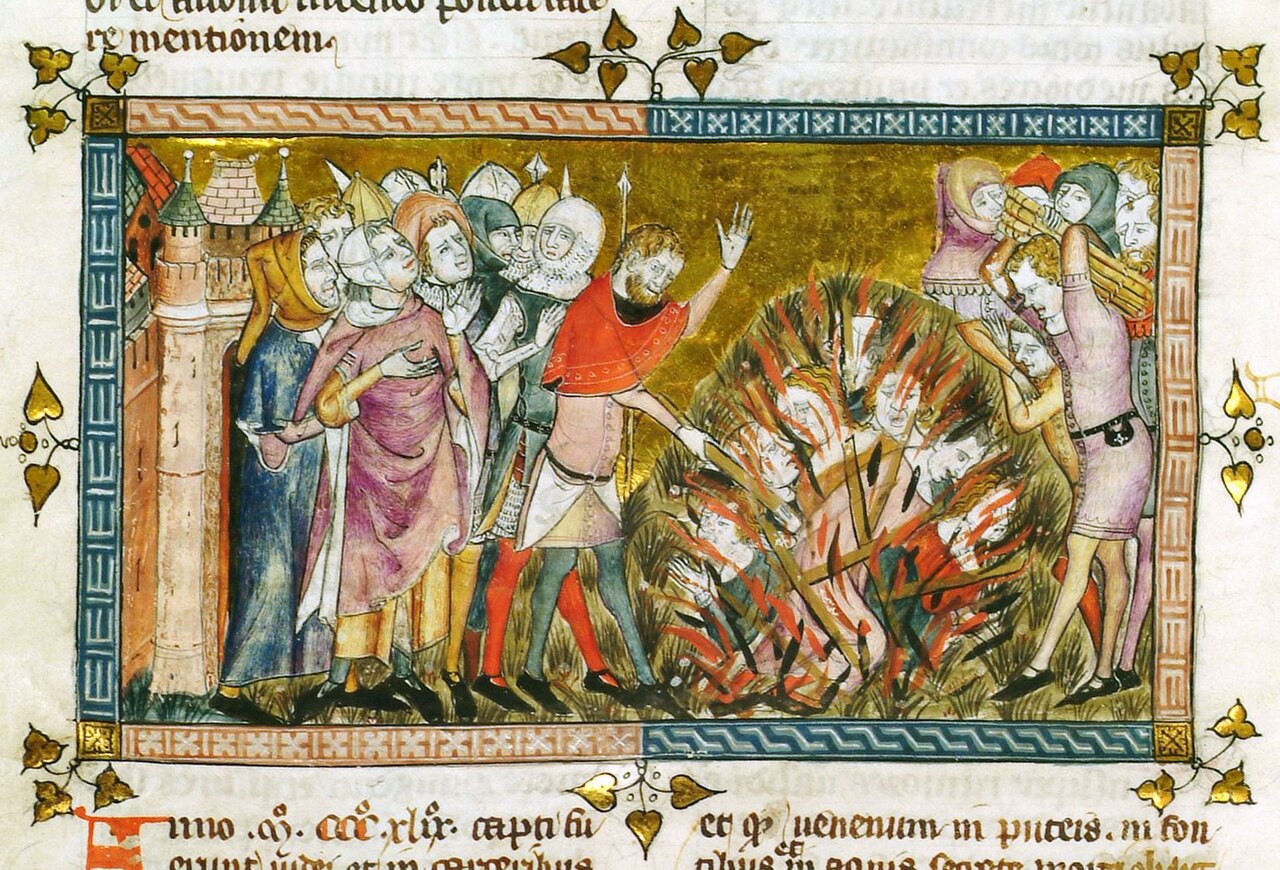
The Jewish residents were accused of poisoning the wells and thus exacerbating the plague. Despite the lack of any credible evidence and some attempts by local leaders and even the Holy Roman Emperor to stop such actions, the mob, and certain city leaders, proceeded with their grim resolve. The Jewish population was forcibly taken to an island on the Rhine, where a wooden structure had been erected. In a devastating act of cruelty, the entire community was locked inside this structure and burned alive. The precise number of victims is hard to ascertain, with historical accounts varying, but it is widely believed that several hundred Jewish individuals, including men, women, and children, met a tragic end that day.
The massacre in Basel was not an isolated incident but part of a wider pattern of pogroms and violence against Jewish communities across Europe, often incited by similar accusations. The scale and brutality of the event sent shockwaves through society, eliciting a range of responses.
Many among the general population, driven by fear of the plague and swayed by prevailing antisemitic sentiments, either participated in the violence or tacitly accepted the scapegoating of the Jewish community. The immediate aftermath for them was a misguided sense of having eliminated a perceived threat, not realizing the moral and humanity loss they had partaken in.
For Jewish communities across Europe, the Basel Massacre was a harrowing symbol of the dangers they faced. It led to a deep sense of mourning and was a stark reminder of their precarious position in medieval society. Many who survived or heard of the massacre sought refuge in more tolerant regions or lived in fear of similar fates.
The reactions of local and regional leaders varied. Some, like the city council of Basel, justified the massacre as a necessary action to combat the plague. In contrast, others, including Emperor Charles IV, were appalled and issued decrees and letters condemning the violence and forbidding further attacks on Jews.
The Church’s response was mixed. Some clergy members vehemently condemned the violence and worked to protect Jewish people, citing Christian doctrine of love and compassion. At the same time, others contributed to the antisemitic rhetoric or remained silent, effectively condoning the actions by their inaction.
The immediate aftermath of the Basel Massacre was a period marked by devastation, reflection, and significant change, both for the city of Basel and Jewish communities across Europe. The massacre, a horrific event fueled by fear, superstition, and deep-seated prejudice, not only decimated the Jewish population of Basel but also set a grim precedent for the treatment of Jews during periods of societal crisis.
In Basel, the massacre resulted in the near-total annihilation of the Jewish community. The loss of so many lives in such a brutal and public manner left a void in the city’s social, cultural, and economic fabric. Jewish people had been integral to the city’s trade and commerce, and their sudden removal would have caused significant disruptions across various sectors. The area where they had lived and worked became a haunting, empty space, a stark reminder of the massacre’s brutality and the community that once thrived there.
Beyond the immediate economic impact, the massacre led to a period of moral and spiritual reckoning for many in Basel and beyond. The sheer horror of the event likely induced a sense of guilt and introspection among some who participated in, witnessed, or acquiesced to the violence. It prompted a questioning of the collective conscience and the societal values that allowed such an atrocity to occur.
The effects of the Basel Massacre reverberated far beyond the city itself, profoundly impacting Jewish communities across Europe. The massacre was part of a broader pattern of pogroms and expulsions that took place during the Black Death, as Jewish people were scapegoated and targeted across the continent. The violence and persecution led to forced migrations and significant changes in the Jewish diaspora. Many Jewish communities were compelled to leave their homes, seeking safety in more tolerant regions or cities, often in Eastern Europe. This resulted in a significant demographic and cultural shift and further entrenched the Jewish people as a nomadic community, continually seeking refuge from persecution.
The persistent cycle of violence and forced migrations had a lasting impact on the Jewish community. It further entrenched antisemitic stereotypes and prejudices into the European psyche, lending false legitimacy to the scapegoating of Jews and contributing to ongoing discrimination. Despite the horrors and continual threats, Jewish communities demonstrated remarkable resilience and adaptability. They continued to maintain their cultural and religious traditions, adapting to new environments and contributing significantly to the societies in which they lived.
The Basel Massacre has been the subject of extensive scholarly interpretation, reflecting on its causes, its brutal nature, and its long-term impact on European Jewish history. This tragic event is often contextualized within the broader history of antisemitism in medieval Europe, particularly during the devastating spread of the Black Death. Scholars have dissected the massacre from various angles, understanding it as a consequence of deep-seated prejudices, economic envy, and societal breakdown during times of crisis.
Scholars point out that the massacre was fueled by a lethal combination of religious fanaticism, economic jealousy, and social hysteria. The Jewish community, which was relatively prosperous and insular, often became the target of envy and suspicion. These sentiments were exacerbated during the Black Death, as fear-stricken populations desperately sought a scapegoat for the inexplicable and unrelenting death around them. The accusations against Jews, such as poisoning wells or conspiring to spread the plague, were baseless but gained traction rapidly, leading to widespread violence.
The Basel Massacre is not an isolated incident but rather part of a series of pogroms and mass killings of Jewish communities throughout Europe during the 14th century. Events in Strasbourg, Worms, Mainz, and countless other cities bear a striking resemblance to the massacre in Basel. These massacres share common patterns: accusations of well poisoning, forced conversions, and the eventual killing or expulsion of Jewish populations. The comparison across these events highlights a broader medieval European phenomenon where crises often culminated in the scapegoating and persecution of Jews.
In the long term, the Basel Massacre and similar events had a profound and lasting effect on European Jewish history. The 14th century became a turning point, leading to significant shifts in the demographics and movements of Jewish populations. As violence spread, Jewish communities were increasingly pushed to the margins of European societies or found themselves seeking refuge in Eastern Europe, where more tolerant conditions prevailed at times. These migrations shaped the cultural and social makeup of Jewish communities, with lasting impacts on language, customs, and religious practices.
The recurring cycle of persecution also had deep psychological and cultural effects on European Jews, fostering a sense of perpetual vulnerability and shaping communal defenses and strategies for survival. The memory of massacres like Basel’s became ingrained in the collective Jewish consciousness, serving as somber reminders of the dangers of scapegoating and the need for vigilance and resilience.
Moreover, the events of the 14th century, including the Basel Massacre, set a precedent for future treatment of Jews in Europe. They contributed to the entrenched stereotypes and prejudices that would persist for centuries, leading to recurrent violence and discrimination against Jewish people. This period underscored the precariousness of Jewish life in Europe and foreshadowed more extensive, organized campaigns of antisemitism in later centuries.
The scholarly interpretations of the Basel Massacre reveal it as a critical event that encapsulates the broader dangers of scapegoating and prejudice during times of crisis. It stands as a testament to the destructive power of hysteria and hatred, serving as a poignant lesson in the history of European antisemitism. The massacre’s comparison with similar events underscores a recurring pattern of persecution that significantly shaped the trajectory of European Jewish history. As we reflect on these dark chapters, they continue to serve as crucial reminders of the importance of tolerance, understanding, and inclusivity in societies across all times and places.
The Basel Massacre of January 9, 1349, stands as a stark reminder of the destructive capabilities of fear, prejudice, and the human tendency towards scapegoating. The way this event is memorialized and remembered is varied and reflects an ongoing struggle to comprehend and learn from such catastrophic moments in human history. Commemoration takes multiple forms, each serving as a poignant reminder and a critical lesson for future generations.
Historical records and scholarly accounts form the primary means through which the Basel Massacre is remembered. These documents provide a narrative of the tragic events, helping to ensure that the horrors of the past are not forgotten. In the Jewish community, the massacre, along with other historical tragedies, is commemorated through liturgical remembrances and in the collective memory of the community. Particularly on Tisha B’Av, a day marked by mourning the numerous calamities that have befallen the Jewish people, the Basel Massacre is remembered in prayers and somber reflection.
In some places, memorials or plaques stand to honor the victims of the massacre, acting as physical embodiments of the community’s collective memory. These serve as silent yet potent reminders of the past, inviting reflection and serving as educational points for the public to learn about the historical events they represent. Moreover, education and public discourse incorporate the Basel Massacre into a broader discussion about medieval history and the history of antisemitism. This inclusion is vital for teaching future generations about the importance of tolerance, understanding, and the respect for human rights.
From the tragic events of Basel, several lessons emerge. The massacre demonstrates the dangers of scapegoating and prejudice, particularly how quickly they can escalate into violence when unchecked by reason and compassion. It underscores the critical need for leadership that does not capitulate to hysteria but instead upholds the values of justice and protection for all community members.
The resilience and remembrance of the Jewish community in the face of such adversity highlight the importance of maintaining cultural and religious identity. This resilience is a testament to the human spirit’s strength and the need to remember and honor the past, no matter how painful. Lastly, the Basel Massacre serves as a historical exemplar of the vital need for universal human rights and the continuous fight against bigotry. It is a grim reminder that society must vigilantly defend the rights and dignity of every individual, standing firmly against the forces of intolerance and hatred.
In commemorating the Basel Massacre, society not only honors the memory of those who suffered and perished but also commits itself to learn from the past. It is a commitment to fostering a more informed, tolerant, and compassionate world, recognizing the inherent dignity and worth of every person. By looking back at the darkest chapters of history, we can strive to ensure that such tragedies are never repeated and that the future is one of unity, respect, and peace for all.




 DAVE DOES HISTORY
Leave a comment