
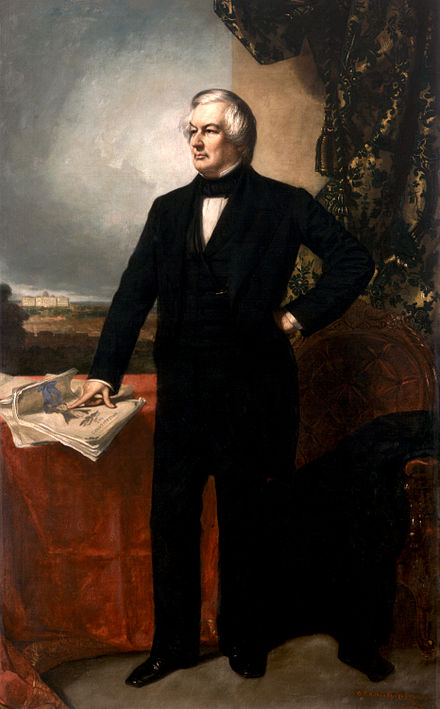
Millard Fillmore, the 13th President of the United States, served from 1850 to 1853 following the untimely death of President Zachary Taylor. Born in a log cabin in the early 19th century and rising from humble beginnings through sheer determination and a fervent belief in self-education, Fillmore’s story is a testament to the American spirit of that era. His presidency is marked by his controversial signing of the Compromise of 1850, a series of laws attempting to quell the growing tensions between the North and the South. Though often overlooked or criticized in historical retrospectives, Fillmore’s life and presidency encapsulate a complex period in American history, characterized by his moderate political stance and efforts to maintain unity during a time of rising sectionalism.
Millard Fillmore, the 13th President of the United States, was born on January 7, 1800, in a log cabin in the Finger Lakes country of New York, to Nathaniel Fillmore and Phoebe Millard. His early life was characterized by the struggle and hardship typical of the American frontier. The Fillmore family, of modest English ancestry, was not affluent, and Millard’s formative years were marked by poverty and limited opportunities.
The second of eight children, Fillmore was born into a world where life on the frontier was demanding. His father, Nathaniel, was a farmer who faced the continual challenge of making a living from the land. As a young boy, Millard was required to assist with farm chores, and his early education was sporadic, fitting around the demands of agricultural life. Despite these challenges, Fillmore’s thirst for knowledge was evident from a young age. His limited access to schooling did not deter him from pursuing an education through self-study and reading whenever he could.
Fillmore’s formal education began with the basic reading, writing, and arithmetic taught in the frontier schools, but it was far from comprehensive or consistent. Recognizing his own need for further education, at the age of 15, he took a job at a cloth mill to fund his own schooling. The hard work and determination he exhibited caught the attention of a New York judge, who offered him a chance to apprentice in his law office. This opportunity was a turning point for Fillmore, providing him not only with legal training but also access to an extensive library. He voraciously read and taught himself law, eventually gaining admission to the bar in 1823.
While his father was primarily a farmer, it was his mother, Phoebe, who instilled in him the importance of education and moral integrity. His parents’ support and the values they imparted played a significant role in shaping his character and ambitions. Despite the family’s economic struggles, they valued education and community, which deeply influenced Fillmore’s later life and career.
Fillmore’s entry into politics was almost as humble as his early life. After establishing himself as a competent lawyer, he became involved in local politics in New York. His first political office was as a member of the New York State Assembly, serving in the Anti-Masonic Party from 1829 to 1831. The Anti-Masonic Party, America’s first third party, was primarily known for its opposition to Freemasonry, but it was also a stepping stone for Fillmore’s entry into national politics. He made a name for himself as a diligent and capable legislator, known for his moderate views and his ability to negotiate and compromise.
In 1832, Fillmore ran for the House of Representatives but lost. Undeterred, he switched to the Whig Party, which better aligned with his views on economic development and tariffs. His persistence paid off, and he was elected to Congress in 1832, serving until 1843. During his tenure, Fillmore gained respect for his mastery of legislative details and his moderate, conciliatory approach. He served as chairman of the powerful Ways and Means Committee, playing a crucial role in crafting fiscal policy.
Throughout his political career, Fillmore advocated for tariffs to protect American industry and supported internal improvements to foster national growth. He was known for his moderate stance on the slavery issue, seeking compromise and national unity above all. His ability to work across the aisle and his reputation for integrity won him allies and respect in Congress.
His key allies were other prominent Whigs, including Henry Clay and Daniel Webster, both of whom influenced his political views and career. Fillmore’s moderate positions and effectiveness in Congress made him a respected figure within the Whig party, setting the stage for his future elevation.
The 1848 Presidential election was a turning point for Fillmore. The Whig party was searching for a Vice Presidential candidate to balance the ticket with the popular war hero, Zachary Taylor, who was a Southerner and slave owner. Fillmore’s Northern roots, along with his experience and moderate stance on divisive issues like slavery, made him an attractive choice. His nomination for Vice President was partly due to his political experience and partly a strategic move by the Whigs to balance regional interests and appeal to a broader electorate.
Fillmore campaigned diligently for the Taylor-Fillmore ticket, which ultimately won a narrow victory. His selection as Vice President was not just a testament to his political acumen and reputation but also a reflection of the era’s political strategies, where balancing regional and sectional interests was crucial for national elections.
Millard Fillmore ascended to the presidency in a time of great national turmoil and division. His presidency, marked by his handling of sensitive issues both domestic and foreign, reflected the complexity and challenges of leading a nation on the brink of civil war.
Fillmore became the 13th President of the United States unexpectedly after the death of President Zachary Taylor in July 1850. Taylor’s sudden demise left the nation in a precarious position, with Fillmore assuming the presidency amidst growing sectional tensions over slavery and state rights. Unlike modern Vice Presidents, Fillmore was not intimately involved in Taylor’s administration, and his ascendancy marked a distinct shift in the White House’s direction.
The most significant issue during Fillmore’s presidency was the Compromise of 1850, a series of bills intended to quell the tensions between slave and free states following the Mexican-American War. The compromise, masterminded by Senator Henry Clay and supported by Senator Daniel Webster, included provisions for admitting California as a free state, setting Texas’s boundaries, and establishing territories with the question of slavery to be decided by popular sovereignty. It also included the Fugitive Slave Act, which mandated federal support for the capture and return of runaway slaves.

Fillmore’s position on the compromise was one of cautious support. He recognized the necessity of conciliation and compromise to avoid disunion. Although he personally disliked slavery, he saw the Compromise of 1850 as essential to maintaining the Union and promptly signed the bills into law. His support for the Fugitive Slave Act, however, would tarnish his reputation among abolitionists and contribute to the country’s continuing sectional divide.
Beyond the Compromise of 1850, Fillmore’s domestic policies included support for internal improvements and a continuation of the Whig economic agenda. He also focused on foreign policy, navigating relations with Japan, opening trade with the Perry Expedition, and maintaining a stance of non-intervention in foreign revolutions, like those occurring in 1848 across Europe.
The Compromise of 1850 had a mixed impact on the country. It temporarily eased tensions between the North and South and postponed the civil war for a decade. However, provisions like the Fugitive Slave Act incited fierce opposition in the North, contributing to the rising abolitionist movement and further polarizing the country. Fillmore’s enforcement of the Act, particularly in notable cases of fugitive slaves, drew ire from his Northern contemporaries and is often viewed critically by historians.
Fillmore’s presidency is frequently evaluated through the lens of his handling of the Compromise of 1850. His support for the compromise demonstrates his commitment to preserving the Union, but his enforcement of the Fugitive Slave Act is seen as a moral failure by many. As a president, Fillmore was a capable administrator and a diligent worker, but he lacked the vision or charisma to move beyond the role of a caretaker president or to significantly alter the course of the nation’s drift toward civil war.
His foreign policy initiatives, particularly in opening Japan to Western trade, are often viewed as successful and forward-thinking, setting the stage for significant developments in international relations. Domestically, however, his inability to provide strong leadership or to alleviate the growing sectional tensions overshadows his administration.
The Whig nominating convention of 1852 marked a critical turning point in American politics and the eventual dissolution of the Whig Party. For Millard Fillmore, it signaled the end of his presidential aspirations and set the stage for the final months of his term.
The 1852 Whig Convention took place against a backdrop of increasing sectional tension within the United States. The Compromise of 1850, while temporarily calming some disputes, had deeply divided the nation and the Whig Party itself. The party, which had been a coalition of various regional and issue-based factions, was increasingly struggling to maintain unity in the face of the divisive issue of slavery.
As the incumbent, Fillmore sought the nomination for a full term. His presidency, marked by the enforcement of the Fugitive Slave Act and other components of the Compromise of 1850, had alienated a significant portion of the Whig base, particularly in the North. Despite this, he maintained a strong following among Southern Whigs and others who appreciated his efforts to preserve the Union and maintain peace between the North and South.
The convention was contentious and divided. Fillmore faced significant opposition from those within his party who were looking for a fresh start with a new candidate. His main rivals for the nomination were General Winfield Scott, a popular military leader, and Senator Daniel Webster.
After a protracted and heated debate and numerous ballots, the convention finally chose General Winfield Scott as the Whig candidate. Scott, perceived as a more electable choice, particularly in the Northern states, was seen as a compromise candidate who might unite the various factions of the party. His military fame and perceived neutrality on the issue of slavery were factors that contributed to his selection over Fillmore.
Not receiving the nomination was a significant personal and political blow to Fillmore. It underscored the deep divisions within the Whig Party and the country that not even an incumbent president could bridge. Fillmore, however, accepted the decision and supported Scott in the general election.
In the remaining months of his presidency, Fillmore continued to administer the duties of his office but with the understanding that his influence and ability to enact significant changes were limited. The focus of his administration shifted to ensuring a smooth transition of power and continuing to address ongoing domestic and foreign issues without the mandate of a fresh electoral victory.
The defeat in the Whig convention also marked the beginning of the end for Fillmore’s political career. He would never hold public office again after leaving the presidency in March 1853. The 1852 election itself was a disaster for the Whigs, with Scott losing in a landslide to Democrat Franklin Pierce, signaling the fracturing and eventual demise of the Whig Party.
After leaving the presidency in 1853, Millard Fillmore’s life continued to be eventful and challenging, marked by personal tragedies and a persistent desire to return to political office. His post-presidency years reflect the complexities of his character and the turbulent times in which he lived.
One of the most significant personal tragedies Fillmore faced after leaving office was the death of his beloved wife, Abigail Powers Fillmore, just a month after the end of his presidency. Abigail had been an integral part of Fillmore’s life, supporting his career and maintaining an active role as the First Lady. Her death left Fillmore devastated and alone in a large and empty house.
The loss was compounded when, only a few years later in 1854, Fillmore’s daughter Mary also died of cholera. Mary’s death was another profound blow to Fillmore, taking away the last of his immediate family. These personal losses deeply affected Fillmore and cast a shadow over his post-presidential years.
Despite these personal losses, or perhaps because of them, Fillmore remained active in politics and harbored a desire to return to significant political office. He was particularly concerned about the preservation of the Union and believed that he could play a role in quelling the rising sectional tensions.
In 1856, Fillmore was nominated by the Know-Nothing Party, also known as the American Party, for President. The party was known for its nativist policies and opposition to immigration, particularly against Catholics. While Fillmore did not fully support all of the party’s positions, he accepted the nomination, seeing it as an opportunity to return to leadership and perhaps steer the country away from an impending crisis. However, he was not successful and finished third in the election, behind James Buchanan and John C. Fremont.
Even after his failed bid to return to the presidency, Fillmore stayed involved in public service and civic affairs. He helped to found the University at Buffalo and served as its first chancellor. He also continued to engage in various civic and national activities, including playing a role in the founding of the Buffalo Historical Society and the Buffalo General Hospital.
Throughout his post-presidential years, Fillmore was conscious of his legacy. He remained active in the Whig Party until its dissolution and then maintained a position as an elder statesman, offering his views on the issues of the day. He was often sought for advice and participation in public events, reflecting a continued respect for his experience and wisdom.

Millard Fillmore’s life, from his humble beginnings in a log cabin to his ascent to the presidency, encapsulates a unique chapter in American history. His tenure as the 13th President is often overshadowed by the nation’s escalating crisis over slavery and his controversial support for the Compromise of 1850, particularly the Fugitive Slave Act. Today, he is remembered as a president whose efforts to maintain unity and compromise reflect the complex and often contradictory currents of pre-Civil War America. Despite being criticized for his policies, especially regarding slavery, and facing personal tragedies after leaving office, his commitment to public service and the significant role he played in a crucial era of the nation’s history cannot be overlooked. His legacy, while mixed, is a testament to the challenges of leadership during one of the most divisive periods in American history, reminding us of the enduring need for leaders who can navigate the fine line between principle and compromise.
 DAVE DOES HISTORY
Leave a comment