
The Battle of the Bulge, officially known as the Ardennes Counteroffensive, was the last major German offensive campaign on the Western Front during World War II. It commenced on December 16, 1944, in the densely forested Ardennes region of Wallonia in Belgium, France, and Luxembourg. The battle derived its name from the German forces’ initial success in pushing the Allied front line westward, creating a noticeable bulge.
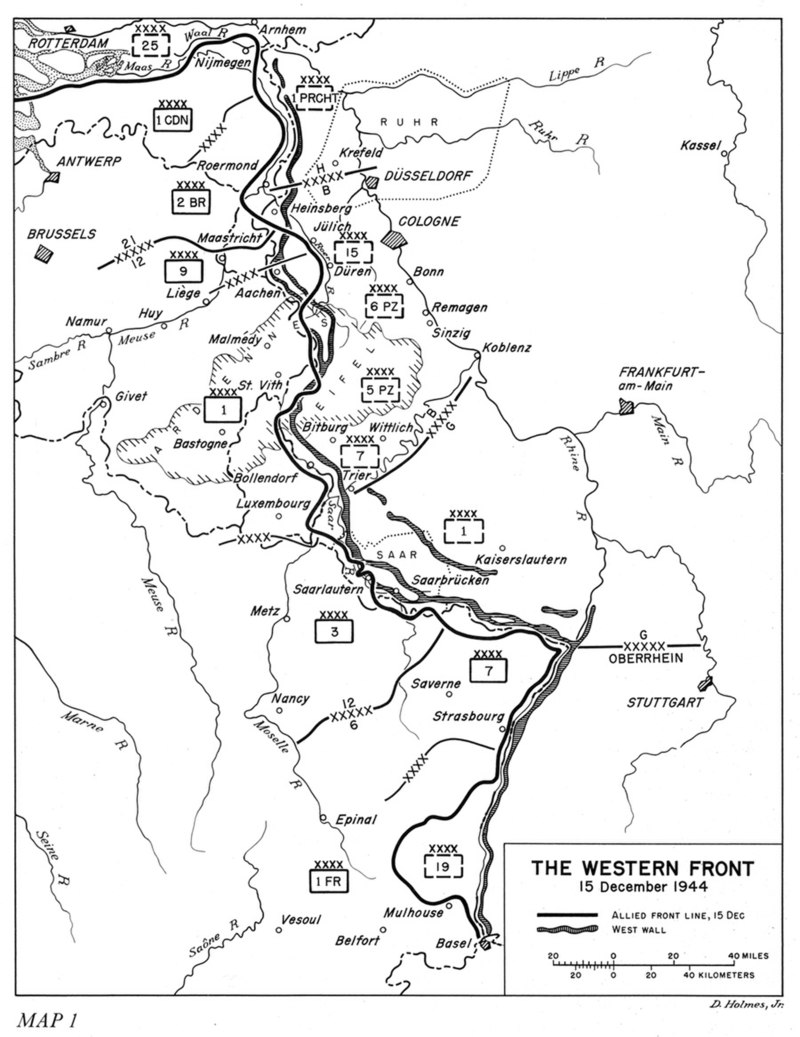 By late 1944, the German war effort was reeling under the cumulative effects of multiple fronts and diminishing resources. Adolf Hitler, desperate to turn the tide, planned a surprise offensive. The goal was to split the British and American lines, capture Antwerp, and encircle four Allied armies, forcing a peace negotiation in the West, allowing Germany to focus solely on the Eastern Front against the Soviet Union.
The German forces, commanded by Generalfeldmarschall Gerd von Rundstedt and Generaloberst Alfred Jodl, assembled in secrecy, mustering substantial resources. This included several Panzer divisions, infantry, and paratroopers. Notable divisions included the 5th Panzer Army led by General Hasso von Manteuffel and the 6th SS Panzer Army under SS-Oberstgruppenführer Sepp Dietrich.
On the Allied side, the initial defense was primarily the responsibility of the American troops. The U.S. forces, caught off guard, were spread thinly across a wide front. Key figures included General Dwight D. Eisenhower, the Supreme Allied Commander, and generals like Omar Bradley and George S. Patton, commanding various Army Groups.
The battle began with a massive artillery barrage, followed by an assault through the Ardennes, exploiting the weakly defended region with the element of surprise and bad weather, which grounded the Allies’ superior air forces. The initial German advance was swift and devastating, creating chaos and confusion among the American ranks. Towns like Clervaux and Saint-Vith saw intense fighting.
Key elements of the surprise attack included the use of English-speaking German soldiers in American uniforms to disrupt communications and spread misinformation, and the targeting of vital crossroads and supply depots to hinder the Allies’ ability to respond effectively.
The first day of the Battle of the Bulge set the stage for what would become the largest and bloodiest single battle fought by the United States in World War II and the third deadliest campaign in American history. While the initial German advance was impressive, the offensive ultimately stretched their capabilities to the breaking point. The Allies, recovering from the initial shock, would regroup, reinforce, and launch a counteroffensive. This battle would not only test the mettle of the American forces but also significantly deplete German resources, contributing to the eventual downfall of the Third Reich.
The first day of the Battle of the Bulge was a testament to the unpredictability of warfare and the resilience of the Allied forces in the face of adversity. It marked the beginning of an arduous and pivotal chapter in World War II, one that would significantly influence the course of the war in the European Theater.



 DAVE DOES HISTORY
Leave a comment