
The Battle of the Falkland Islands, which took place on December 8, 1914, during World War I, was a crucial naval engagement between the British Royal Navy and the Imperial German Navy. This battle, notable for its strategic implications in the South Atlantic, marked a significant chapter in the early naval history of the First World War.
The battle’s origins lay in the broader context of the global conflict. With the outbreak of World War I in August 1914, the German East Asia Squadron, under Vice-Admiral Maximilian von Spee, was stationed in the Pacific Ocean. Von Spee’s squadron had successfully raided British shipping and defeated a British squadron at the Battle of Coronel on November 1, 1914, off the coast of Chile. This victory prompted the British to dispatch a stronger force to neutralize the German threat in the South Atlantic and Pacific.
The strategic situation at the time was tense, with the British Empire striving to maintain its naval supremacy. The Royal Navy was stretched thin, protecting its global empire and trade routes. The German East Asia Squadron, although smaller, posed a significant threat to British interests in the Southern Hemisphere. The British Admiralty, under First Lord Winston Churchill, was determined to avenge the defeat at Coronel and eliminate the German squadron.
The British forces were led by Vice-Admiral Sir Doveton Sturdee. His squadron included two battlecruisers, HMS Invincible and HMS Inflexible, and a number of smaller cruisers and auxiliary ships. The German squadron, commanded by Vice-Admiral von Spee, comprised two armored cruisers, SMS Scharnhorst and SMS Gneisenau, and several light cruisers.
The battle was chiefly a contest between two skilled naval commanders: Vice-Admiral Sir Doveton Sturdee for the British and Vice-Admiral Maximilian von Spee for the Germans. Both were experienced officers, but Sturdee’s advantage lay in having faster and more heavily armed ships.
The battle commenced when the German squadron, unaware of the British presence, approached the Falkland Islands to raid the British wireless station and coaling facilities. The British fleet, having been forewarned, was prepared and caught the Germans by surprise. In the ensuing battle, the superior speed and firepower of the British battlecruisers proved decisive. Both the Scharnhorst and Gneisenau were sunk, along with several smaller ships. The Germans suffered heavy losses, including the death of von Spee.
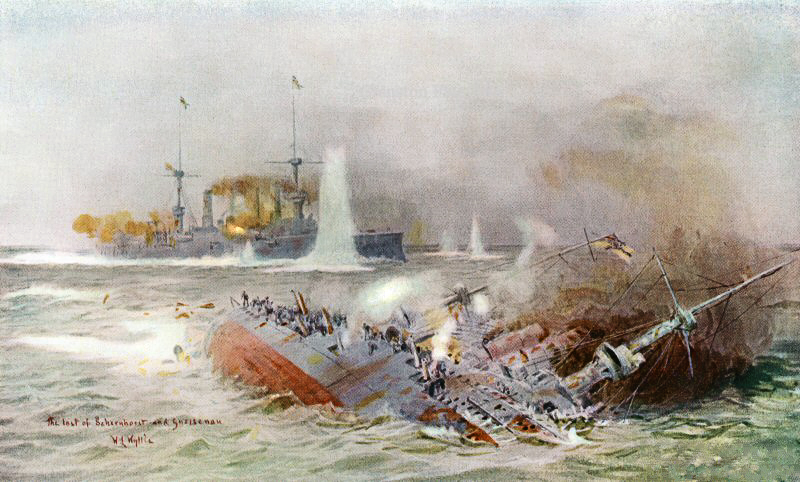
The aftermath of the battle was significant for both sides. For the British, it was a much-needed victory that avenged the defeat at Coronel and restored naval prestige. It also effectively eliminated the German naval threat in the South Atlantic and Pacific. For Germany, the defeat was a major blow, resulting in the loss of valuable ships and experienced sailors, and diminishing their naval capabilities.
The legacy of the Battle of the Falkland Islands is multifaceted. It underscored the importance of naval power in global warfare, particularly in controlling sea lines of communication and trade routes. The battle also highlighted the effectiveness of battlecruisers, which combined the firepower of a battleship with the speed of a cruiser. Additionally, it demonstrated the impact of intelligence and preparation in naval warfare. The battle remains a significant study in naval strategy and tactics and is remembered as a key episode in the naval history of World War I.
In the remote, windswept Falkland Islands, December 8th holds a special place in the hearts of the islanders. This date, known as “Battle Day,” commemorates the Battle of the Falkland Islands, a significant naval engagement during World War I. Over a century later, the day is not just a remembrance of a distant battle but a celebration of the island’s rich history, resilience, and enduring spirit.
The Battle of the Falkland Islands, fought on December 8, 1914, was a decisive victory for the British Royal Navy over the Imperial German Navy. This victory was crucial in securing the South Atlantic and Pacific waters and marked a turning point in the naval aspect of World War I. For the Falkland Islanders, the battle symbolized their strategic importance and their connection to broader global events.
Today, Battle Day is a poignant mix of solemn remembrance and festive celebration. The day begins with a memorial service, often held at the 1914 Battle Memorial in Stanley, the capital. This service is attended by local dignitaries, veterans, residents, and occasionally representatives from the UK and other nations.
The ceremony includes the laying of wreaths, a moment of silence, and the playing of the Last Post, a bugle call traditionally played at military funerals and commemorations. These acts of remembrance honor not only those who fought in the Battle of the Falkland Islands but also the Falkland Islanders’ contributions to both World Wars.
Following the somber reflection, the mood shifts to a more celebratory atmosphere. The community comes together for various events, including parades, community feasts, and cultural displays. These festivities showcase the unique Falkland Islands culture, which blends British influences with the distinct local customs that have developed over generations.
An essential part of Battle Day is educating younger generations about the island’s history. Schools often organize history lessons, exhibitions, and activities focused on the Battle of the Falkland Islands. This education ensures that the significance of the day, and the sacrifices made, are not forgotten.
For the residents of the Falkland Islands, Battle Day goes beyond commemorating a historical event. It’s a symbol of their resilience, a community that has faced numerous challenges throughout its history, from the harsh Antarctic climate to political disputes over sovereignty.
The day also serves as a reminder of the strategic importance of the Falkland Islands, a place that has been a focal point in global affairs more than once. It underscores the islanders’ pride in their heritage and their determination to preserve their way of life.
In the Falkland Islands, Battle Day is a powerful testament to the enduring spirit of a small community in a remote part of the world. It honors the past while celebrating the present, blending solemnity with festivity, and ensuring that the legacy of a crucial moment in history lives on in the hearts and minds of each generation. This annual event symbolizes not just a victory in a long-ago battle but the ongoing resilience and unity of the Falkland Islanders.



 DAVE DOES HISTORY
Leave a comment