
The 1824 United States presidential election, often referred to as the “Corrupt Bargain,” stands as a pivotal moment in American political history. It was an election that not only tested the young nation’s democratic ideals but also set a precedent for political intrigue and the power of backroom deals.
In the wake of the Era of Good Feelings, characterized by the dominance of the Democratic-Republican Party and the collapse of the Federalist Party, the election of 1824 presented a unique political scenario. There were four major candidates, all from the same party, but with distinctly different regional and political bases. These candidates were John Quincy Adams, Henry Clay, William H. Crawford, and Andrew Jackson.
Adams, the Secretary of State, was known for his diplomatic skills and was popular in the Northeast. Henry Clay, the Speaker of the House, championed the American System and had a strong base in the West. William H. Crawford, the Secretary of the Treasury, was favored by the party establishment but was hindered by poor health. Andrew Jackson, a war hero famous for his victory in the Battle of New Orleans, was immensely popular among the common people, especially in the South and the frontier states.
The campaign was marked by a lack of focus on specific policy issues and more on the personalities and regional loyalties of the candidates. The absence of a clear party divide meant that candidates had to rely on their personal appeal and regional issues. The campaign saw a shift from the elite decision-making process to one that involved more popular participation, reflecting the growing democratic sentiment in the country.
When the votes were tallied, no candidate had secured a majority in the Electoral College, although Jackson had won the most electoral votes and the popular vote. The 12th Amendment to the Constitution dictated that in such a scenario, the House of Representatives must choose the president from the top three candidates. This led to Henry Clay, who finished fourth, being eliminated from contention but holding a significant role as a power broker in the House.
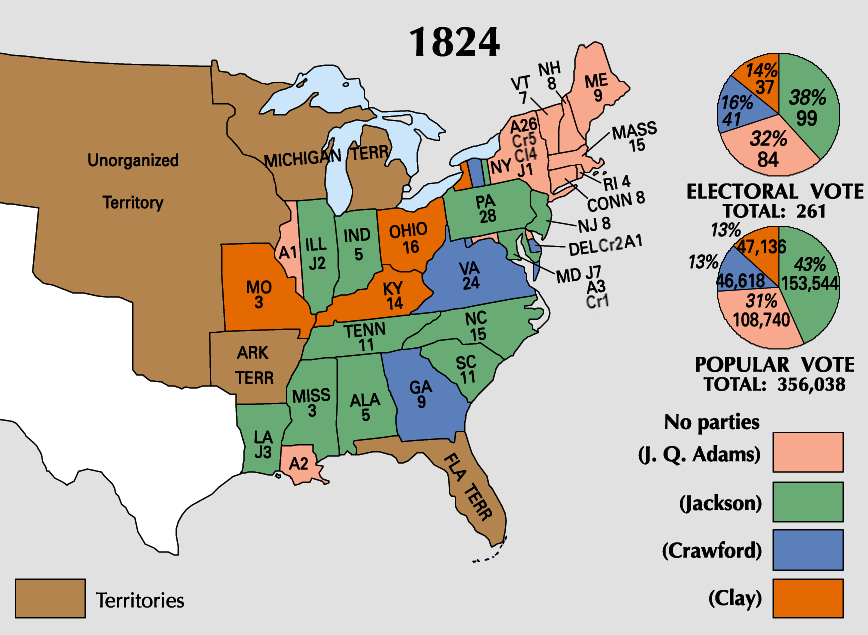
The invocation of the 12th Amendment on the December 1, 1824, threw the election into the realm of Congressional politics. Intense debates and negotiations ensued in the House of Representatives. The key issue was how the representatives would vote, whether they would follow the will of their constituents or their personal preferences and political alliances.

The most controversial aspect of the election was what came to be known as the “Corrupt Bargain.” Henry Clay, who wielded significant influence in the House, threw his support behind John Quincy Adams. Subsequently, when Adams won the presidency, he appointed Clay as his Secretary of State, a position historically seen as a stepping stone to the presidency. This sequence of events led to widespread allegations of a corrupt deal, although no concrete evidence was ever presented.
The aftermath of the election saw a bitter and divided public reaction. Supporters of Jackson were outraged, viewing the outcome as a theft of the presidency and a betrayal of democratic principles. This sentiment laid the groundwork for the rise of Jacksonian democracy and the eventual formation of the Democratic Party.
The election of 1824 had lasting implications for American politics. It underscored the importance of the Electoral College system and its potential complexities. It also highlighted the growing power of popular opinion in presidential politics, setting a precedent for future elections.
The 1824 election was more than just a contest for the presidency; it was a reflection of the evolving political landscape of the United States, signaling the end of one era and the beginning of another. Its legacy lies in its demonstration of the complexities of democracy and the unpredictable nature of political alliances.



 DAVE DOES HISTORY
Leave a comment