
The USS Liscome Bay (CVE-56), named after a bay in Alaska’s Alexander Archipelago, was a significant vessel in the United States Navy during World War II. Launched in April 1943 and commissioned in August of the same year, she was the second of fifty Casablanca-class escort carriers built for the war effort. The ship, constructed by the Kaiser Shipbuilding Company in Vancouver, Washington, was initially intended for the British Royal Navy but was retained by the U.S. Navy and named after a tradition of naming escort carriers after bays in Alaska.
Liscome Bay was characterized by its 512 ft length, 65 ft beam, and 20 ft draft, displacing 8,188 long tons. It was powered by two Uniflow reciprocating steam engines, enabling a speed of 19 knots. The ship’s design featured a 257 ft long hangar deck and a 477 ft long flight deck. To facilitate aircraft movements, she was equipped with an aircraft catapult, two elevators, and had a cruising range of 10,240 nautical miles at 15 knots.
After her commissioning, Liscome Bay quickly engaged in operations, ferrying 60 aircraft from San Francisco to San Diego in September 1943. She was then designated as the flagship of Carrier Division 24 under Rear Admiral Henry M. Mullinnix. After receiving her aircraft contingent, Liscome Bay departed for Pearl Harbor in October 1943, where she conducted further drills before joining the invasion fleet for Operation Galvanic, the assault on the Gilbert Islands.
During the Gilbert Islands campaign, particularly in the invasion of Makin, Liscome Bay played a crucial role. Her aircraft provided close air support and bombed Japanese positions, significantly aiding in the capture of Makin Island. The carrier’s planes logged 2,278 combat sorties as part of Operation Galvanic, which aimed to neutralize enemy airbases and support U.S. Army and Marine landings.
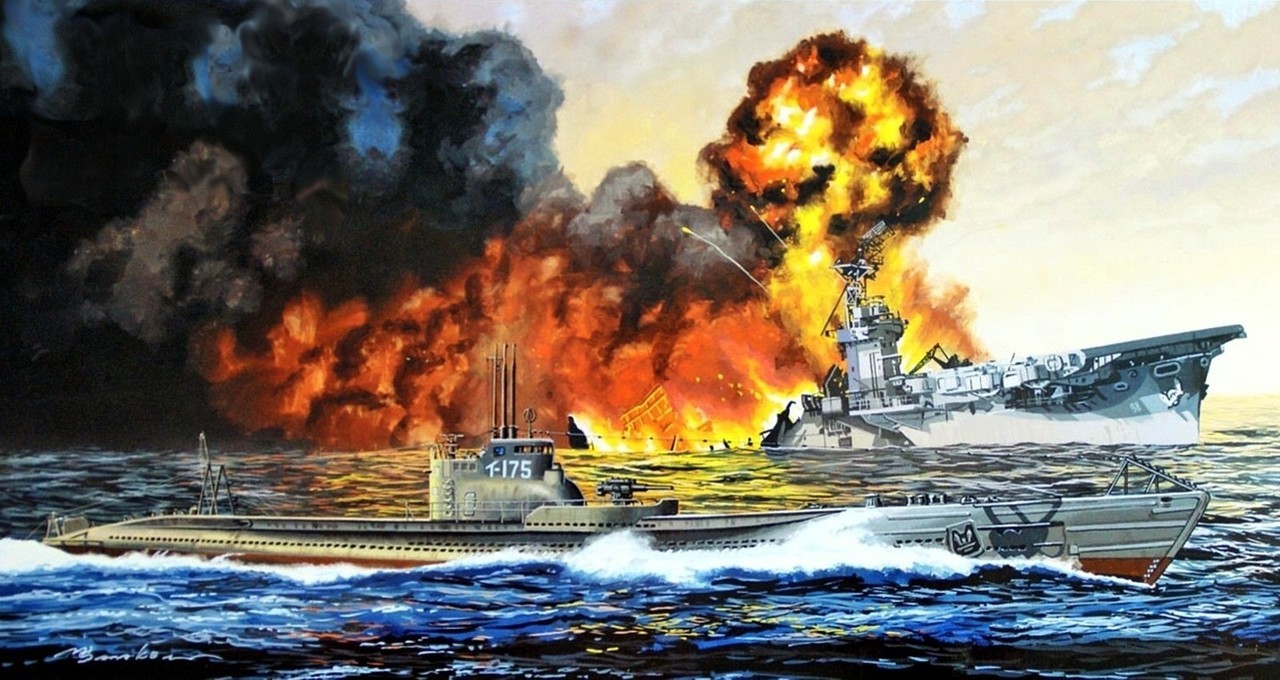
NAVSOURCE
However, the USS Liscome Bay’s service was abruptly and tragically cut short. On November 24, 1943, while stationed 20 miles southwest of Butaritari Island, the ship was struck by a torpedo from the Japanese submarine I-175. The torpedo hit near the bomb magazine, causing a catastrophic explosion that quickly sank the ship in just 23 minutes. This tragic incident led to the loss of 644 men, including Captain Irving D. Wiltsie, Rear Admiral Henry M. Mullinnix, and Ship’s Cook Third Class Doris Miller, the first African-American to receive the Navy Cross for his heroic actions at Pearl Harbor.
Among the notable crew members lost were Chief of Staff of Carrier Division 24, John G. Crommelin, and the brothers William H. Hollister & Richard J. Hollister. Also lost was legal scholar Robert Keeton, who would posthumously become a United States District Judge. The USS Liscome Bay’s loss remains the deadliest sinking of a carrier in the history of the United States Navy.


 DAVE DOES HISTORY
Leave a comment