
The Santa Fe Trail, established during the early 19th century, stands as a significant landmark in the expansion of the American West. This historic route not only facilitated trade but also played a pivotal role in shaping the cultural and economic landscape of the United States.
The trail’s inception can be traced back to the arrival of William Becknell in Santa Fe on November 16, 1822. Becknell, an American trader, embarked on this journey to open up a commercial route between the United States and the Mexican province of Santa Fe de Nuevo México. His successful venture marked the establishment of the Santa Fe Trail, a route that soon became a crucial artery for trade in the region.
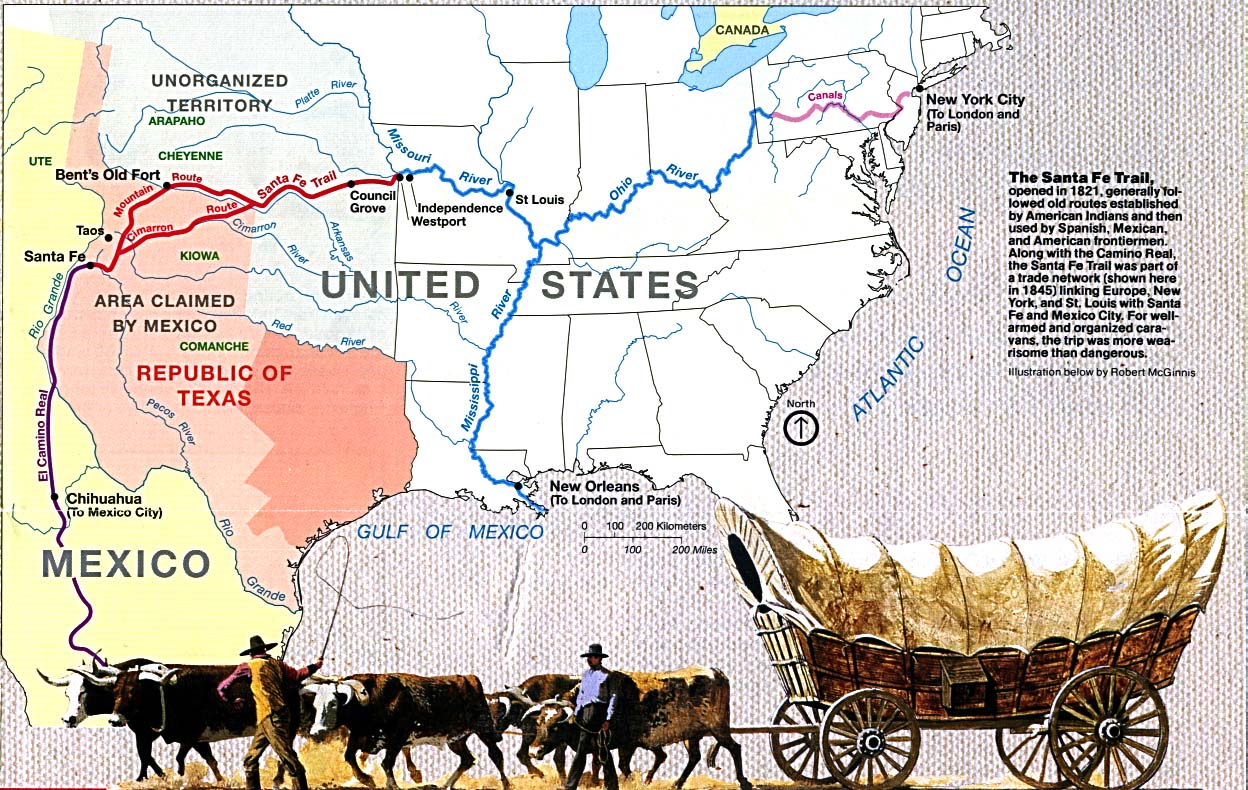 Map of the Santa Fe Trail – Public Domain
The trail was particularly important for North-South trade, acting as a conduit for a diverse array of goods, including textiles, metals, firearms, and spices. This trade route significantly boosted the economies of both the American frontier and Mexican territories. Moreover, it wasn’t just a pathway for goods but also facilitated cultural and information exchanges, thereby knitting together a diverse cultural tapestry across the region.
Despite its commercial success, the Santa Fe Trail existed during a period marked by strained relations between the United States and Mexico. Political tensions often translated into risks for traders, including tariffs and trade restrictions. These tensions eventually culminated in the Mexican-American War between 1846 and 1848, altering the trail’s usage and its geopolitical significance.

The trail also played a critical role in the development of railroad plans in the United States. It demonstrated the feasibility and economic potential of a transcontinental route. This was later exemplified by the establishment of the Atchison, Topeka & Santa Fe Railway, which followed much of the trail’s original route, underscoring its strategic importance.
Spanning from Franklin, Missouri, the Santa Fe Trail traversed through Kansas, Oklahoma, and New Mexico. The journey along this route was fraught with challenges, including harsh weather conditions, difficult terrains such as prairies, deserts, and mountains, and long distances without water sources. Travelers also faced threats from conflicts with Native American tribes, bandits, and the ever-present danger of diseases in an era of limited medical knowledge.
Recognizing its historical importance, parts of the Santa Fe Trail have been preserved as the Santa Fe National Historic Trail. These preserved landmarks and segments serve not only as a reminder of the past but also as educational sites that offer insights into this crucial period of American history.
The legacy of the Santa Fe Trail is profound. It symbolizes the early American spirit of entrepreneurship and exploration and reflects the complex interactions between different cultures and nations. As a chapter in the history of the United States, the trail encapsulates a period of growth, challenge, and change, and continues to be celebrated as a testament to the resilience and determination of early American pioneers and traders.

End of Santa Fe Trail marker in Santa Fe, New Mexico, CC by-SA 3.0 DEED




 DAVE DOES HISTORY
Leave a comment