
The Battle of Cajamarca, a pivotal event in the history of the Americas, occurred on November 16, 1532. This confrontation marked a significant turning point in the Spanish conquest of the Incan Empire and had profound implications for the region’s future.
Before the battle, the Spanish conquistador Francisco Pizarro had landed in Peru with a small force of men, seeking to conquer the vast and wealthy Incan Empire. The Incas, meanwhile, were undergoing a civil war between two brothers, Atahualpa and Huáscar. Atahualpa emerged victorious from this conflict just as Pizarro arrived. The meeting between Pizarro and Atahualpa was set in Cajamarca, where Atahualpa was encamped with a large army.
From the Incan perspective, the Battle of Cajamarca was a shocking and devastating betrayal. The Incas, under Atahualpa, did not expect a violent encounter, believing the meeting to be a peaceful exchange. Atahualpa arrived with thousands of unarmed followers, prepared for a ceremonial event. The Spanish, however, had planned an ambush.
The Spanish forces, though significantly outnumbered, were armed with firearms, cannons, and cavalry – technologies unknown to the Incas. Pizarro launched a surprise attack on the Incas, creating chaos and panic. The Spanish quickly overwhelmed the Incas, slaughtering thousands. Most crucially, they captured Atahualpa, the Incan emperor, which was a significant blow to the Incan command structure.
The immediate aftermath of the Battle of Cajamarca was the collapse of order within the Incan Empire. With their leader captured, the Incas were in disarray. Pizarro used Atahualpa as a puppet to control the empire, demanding a ransom for his release. Despite the Incas paying a vast ransom, Pizarro executed Atahualpa in 1533, further destabilizing the empire.
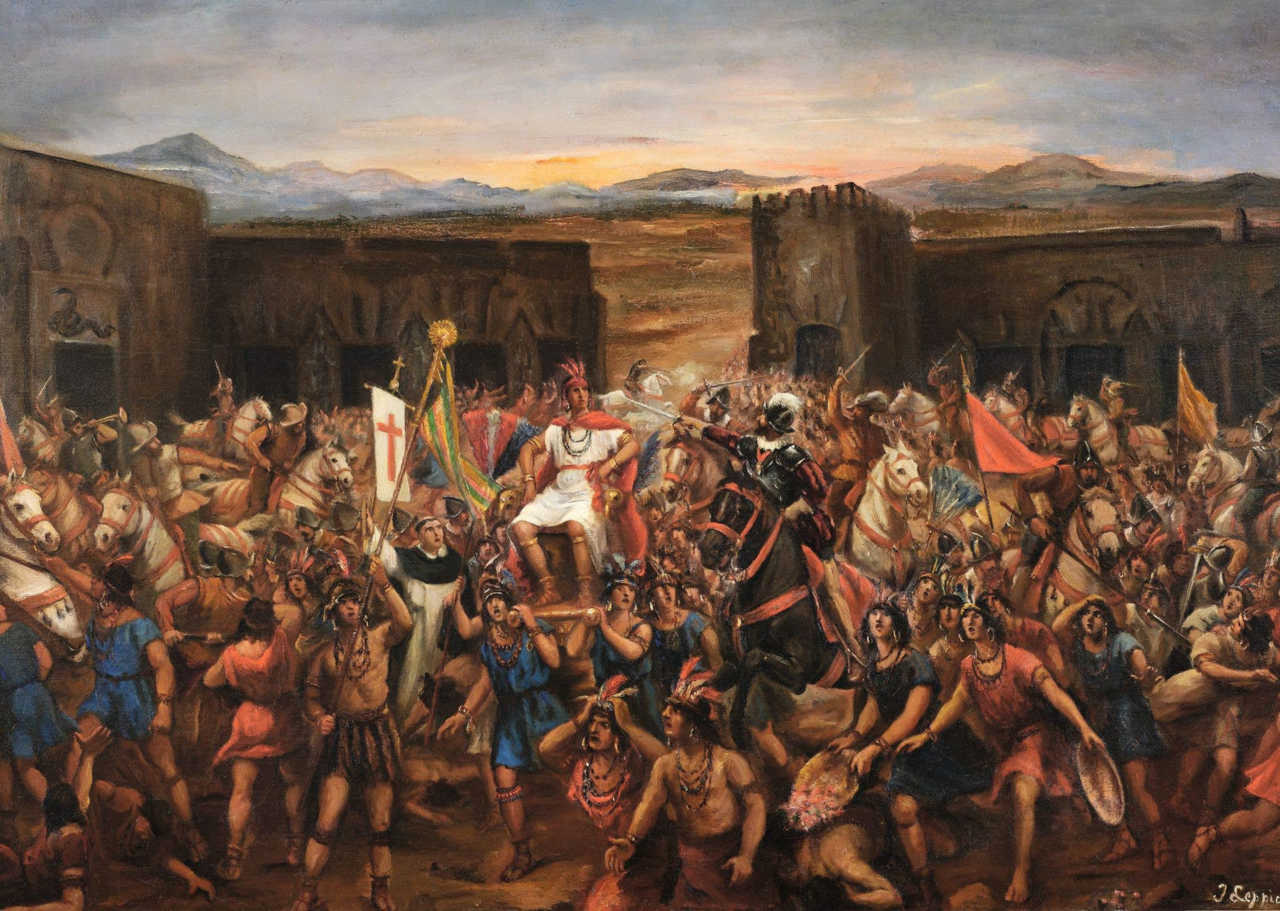
Oil painting depicts The Capture of Atahualpa in Cajamarca (Battle of Cajamarca) and the Spanish conquest of the Inca Empire in 1532. The artwork was made between 1920-1927 by Juan Lepiani. – Public Domain
The capture and subsequent murder of Atahualpa led to a power vacuum within the Incan Empire. It significantly weakened the empire’s ability to resist Spanish conquest. The Spanish exploited this weakness, gradually taking control over the vast territories of the empire. This event marked the beginning of the end for the Incan civilization as a sovereign entity.
The Battle of Cajamarca is remembered as a stark example of the devastating impact of European colonization in the Americas. It symbolizes the drastic clash of cultures, the destructive power of European military technology and tactics against indigenous populations, and the tragic downfall of one of the most sophisticated civilizations in the pre-Columbian Americas. The battle has been extensively studied and remains a subject of historical and ethical debate, highlighting themes of conquest, greed, betrayal, and the catastrophic consequences of cultural misunderstandings.


 DAVE DOES HISTORY
Leave a comment