
Robert Fulton, born on November 14, 1765, in Little Britain, Pennsylvania, was a pioneering American inventor, engineer, and artist who left an indelible mark on the history of transportation. Best known for his groundbreaking work in steamboat technology, Fulton’s inventions transformed water transportation and played a pivotal role in the Industrial Revolution. This biographical article explores the life and inventions of Robert Fulton, a visionary whose innovative spirit continues to influence modern transportation systems.
Robert Fulton’s early life was marked by his artistic talent and an insatiable curiosity about mechanics. As a young man, he displayed a remarkable aptitude for painting and became an accomplished portrait artist, earning a living through his artistic skills. However, it was his fascination with engineering and invention that ultimately led him down a different path.
One of Fulton’s earliest inventions was the development of a practical submarine. In the late 18th century, during the Napoleonic Wars, Fulton designed and built a prototype submarine called the “Nautilus.” This vessel was intended for military use and was equipped with mechanisms for attaching and detonating underwater explosives. Although the submarine did not achieve widespread success, it laid the foundation for Fulton’s future endeavors in engineering and transportation.
Robert Fulton’s most enduring legacy lies in his contributions to steamboat technology. He collaborated with inventor Robert R. Livingston to develop the first commercially successful steam-powered vessel in the United States, known as the “Clermont” or “North River Steamboat.” In 1807, the Clermont made its historic voyage along the Hudson River, traveling from New York City to Albany, a distance of 150 miles, in just 32 hours. This achievement marked a significant milestone in transportation history, as it demonstrated the practicality and efficiency of steam-powered boats for commercial use.
Fulton’s steamboat design featured a high-pressure steam engine, paddlewheel propulsion, and a streamlined hull, making it highly efficient for both passengers and cargo. The success of the Clermont paved the way for the rapid expansion of steamboat travel along American waterways, opening up new opportunities for trade, transportation, and economic growth.
Robert Fulton’s innovations extended beyond steamboat technology. His partnership with Robert R. Livingston also played a crucial role in the development of the Erie Canal. Fulton’s steamboats provided a reliable means of transporting materials and equipment needed for the construction of the canal, which connected the Great Lakes to the Hudson River, dramatically reducing shipping costs and fostering economic development in the region.
Robert Fulton’s contributions to transportation had a profound and lasting impact on American and global commerce. His steamboat designs laid the groundwork for the development of modern steam-powered ships, which transformed international trade and travel. Fulton’s vision and engineering prowess helped shape the future of transportation, making it faster, more reliable, and accessible to a wider range of people.
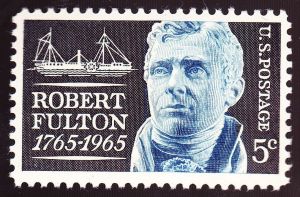 In recognition of his achievements, the United States Postal Service issued a commemorative stamp featuring Robert Fulton in 1987. His name lives on in the many streets, schools, and institutions named in his honor across the United States.
Robert Fulton’s journey from a young artist to a pioneering inventor and engineer exemplifies the power of curiosity, innovation, and determination. His inventions, particularly the steamboat, revolutionized transportation, ushering in a new era of economic growth and connectivity. Fulton’s legacy continues to inspire generations of inventors and engineers, reminding us that with vision and perseverance, we can shape the world and leave an indelible mark on history.



 DAVE DOES HISTORY
Leave a comment