
The Battle of Ia Drang, fought during the Vietnam War, holds a significant place in American military history. It marked the first major engagement between the United States Army and the People’s Army of Vietnam (PAVN). This battle, which occurred in the Ia Drang Valley in South Vietnam, was a crucial moment in the early stages of America’s involvement in the conflict. This article will delve into the events of the first day of the Battle of Ia Drang, discussing the background, American plans, landings, troop movements, and the conditions leading into the second day of battle.
By 1965, the Vietnam War had escalated significantly, with the United States becoming deeply involved in an attempt to prevent the spread of communism in Southeast Asia. The North Vietnamese Army, backed by the Soviet Union and China, sought to reunify Vietnam under communist rule. The Ia Drang Valley, located in the Central Highlands of South Vietnam, was strategically important as it served as a gateway to Cambodia and offered a route for North Vietnamese forces to infiltrate South Vietnam.
The American plan for the Battle of Ia Drang was codenamed Operation Silver Bayonet. It was a search-and-destroy mission with the objective of locating and engaging the North Vietnamese forces in the Ia Drang Valley. The 1st Cavalry Division (Airmobile), led by Brigadier General Richard Knowles, was tasked with carrying out this operation.
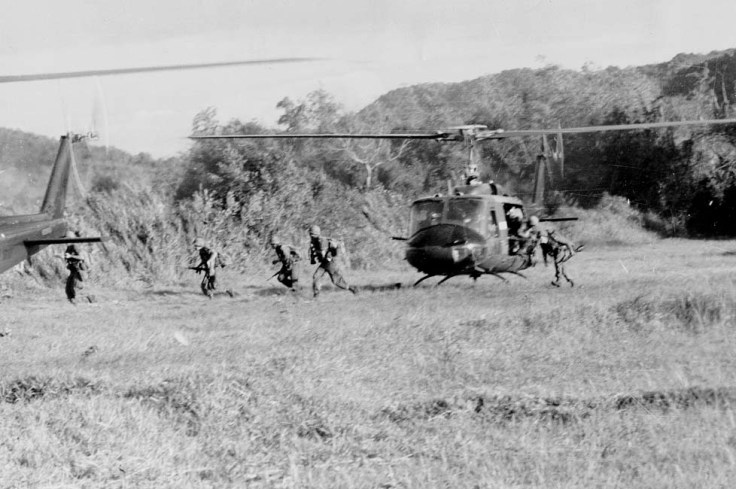
Public Domain
On November 14, 1965, the 1st Cavalry Division launched a heliborne assault into the Ia Drang Valley. Troops from the 1st Battalion, 7th Cavalry Regiment, under the command of Lieutenant Colonel Harold G. Moore, were airlifted into Landing Zone X-Ray. Meanwhile, the 2nd Battalion, 7th Cavalry Regiment, commanded by Lieutenant Colonel Robert McDade, landed at Landing Zone Albany.
Soon after the initial landings, the American forces encountered fierce resistance from the North Vietnamese Army. The PAVN, under the command of General Nguyen Huu An, had prepared an elaborate defensive network of bunkers and trenches. The Americans faced relentless attacks and were soon cut off from their landing zones, leaving them surrounded by enemy forces.
Throughout the first day of battle, American troops at LZ X-Ray and LZ Albany fought fiercely to hold their positions and repel the North Vietnamese attacks. At LZ X-Ray, Lt. Col. Moore’s men faced intense firefights and suffered heavy casualties. Air support played a crucial role in helping them hold their ground. Meanwhile, at LZ Albany, the situation was equally dire as the 2nd Battalion faced determined PAVN forces.
As night fell on the first day of the Battle of Ia Drang, both American battalions had suffered significant casualties, and the situation remained precarious. Communication with higher headquarters was sporadic, and the troops were exhausted and low on ammunition. However, they had managed to hold their positions against overwhelming odds.
The first day of the Battle of Ia Drang had been a brutal and grueling introduction to the harsh realities of combat in Vietnam. The American soldiers had shown remarkable resilience and courage in the face of adversity, but the battle was far from over. The conditions leading into the second day were uncertain, and the outcome of the entire operation hung in the balance.
The first day of the Battle of Ia Drang was a pivotal moment in the Vietnam War, showcasing the determination and bravery of American troops in the face of a formidable enemy. The battle would continue for several more days, ultimately resulting in heavy casualties on both sides. The lessons learned from this engagement would shape American military tactics and strategies for the remainder of the war, making Ia Drang a critical chapter in the history of the conflict.




 DAVE DOES HISTORY
Leave a comment