
The 1st Naval Battle of Guadalcanal, also known as the Battle of Savo Island, took place on the night of November 12-13, 1942, during the early stages of the Guadalcanal campaign in World War II. This battle was a crucial engagement in the broader Pacific theater and had significant implications for the overall strategic situation in the region.
In the late summer and early fall of 1942, the United States and its allies were attempting to establish a foothold on Guadalcanal and nearby islands in the Solomon Islands chain. The strategic objective was to secure the airfield on Guadalcanal, Henderson Field, and use it to contest Japanese control of the region, disrupting their lines of communication and supply between Japan and their forward bases in the South Pacific. Controlling Guadalcanal was essential for both sides, as it would provide a valuable staging point for future operations.
The US Navy faced several challenges leading up to the 1st Naval Battle of Guadalcanal. They were in the process of reinforcing their positions on Guadalcanal, which required the delivery of troops and supplies to the island. However, they were aware of Japanese naval superiority in the area, which posed a constant threat to these supply convoys. Additionally, the US Navy had limited experience in nighttime naval warfare, which put them at a disadvantage given the propensity for night engagements in the waters around Guadalcanal.
Order of Battle – November 13, 1942:
US Navy:
– Task Force 67, commanded by Rear Admiral Daniel J. Callaghan, consisted of two groups:
– Southern Group: Cruiser USS San Francisco, Destroyers USS Aaron Ward, USS Sterett, and USS Laffey.
– Northern Group: Cruiser USS Portland, Destroyers USS Buchanan, USS Cushing, and USS McCalla.
Imperial Japanese Navy:
– Vice Admiral Hiroaki Abe’s force included the heavy cruisers Chokai, Aoba, Kinugasa, and Furutaka, as well as the destroyers Fubuki, Hatsuyuki, Shirayuki, Murakumo, and Shirakumo.
On the night of November 12-13, 1942, the Japanese force under Vice Admiral Abe approached Guadalcanal with the intention of bombarding Henderson Field and disrupting the American efforts on the island. The American Southern Group, led by Rear Admiral Callaghan, was stationed between the Japanese force and Guadalcanal, while the Northern Group, led by Rear Admiral Scott, was further north.
The two forces stumbled upon each other in a confused and chaotic night engagement. The opening salvos were fired at close range, and the Americans were taken by surprise. The combat was fierce, with both sides suffering heavy casualties. The cruiser USS Atlanta was among the early casualties for the US Navy.
The American formation quickly devolved into chaos, with ships maneuvering independently in the darkness. This disorganization contributed to friendly fire incidents and made it difficult for the US Navy to coordinate their efforts effectively. The USS San Francisco, where Admiral Callaghan was stationed, was heavily damaged, and Admiral Callaghan himself was killed in action.
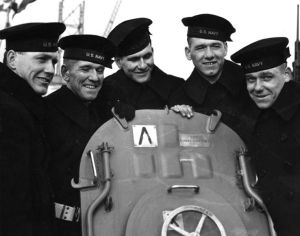
Public Domain
The Japanese heavy cruisers began to target the American ships at close range, causing severe damage. Despite their losses, the American destroyers launched torpedoes at the Japanese cruisers, causing substantial damage to the Chokai and Kinugasa.
Ultimately, the Battle of Savo Island was a tactical victory for the Japanese. They managed to inflict heavy damage on the American force, sinking or severely damaging several cruisers and destroyers. However, the Japanese did not achieve their strategic objectives, as they failed to disrupt Henderson Field or impede the flow of supplies to Guadalcanal.
The US Navy suffered significant losses in this engagement, with four cruisers (USS Atlanta, USS San Francisco, USS Juneau, and USS Portland) and two destroyers (USS Barton and USS Monssen) sunk, and many others damaged. The Japanese also suffered damage to several of their ships.
The 1st Naval Battle of Guadalcanal was a chaotic and brutal nighttime engagement that highlighted the challenges faced by both the US Navy and the Imperial Japanese Navy in the waters around Guadalcanal. While the Japanese achieved a tactical victory, their failure to disrupt American operations on the island allowed the US to ultimately prevail in the Guadalcanal campaign. This battle underscored the importance of nighttime naval tactics and the need for improved coordination and training within the US Navy.



 DAVE DOES HISTORY
Leave a comment