
Susan B. Anthony, born on February 15, 1820, in Adams, Massachusetts, is a towering figure in American history, renowned for her unyielding advocacy for women’s rights, particularly women’s suffrage. Over her lifetime, Anthony faced numerous adversities in her quest to secure equal rights for women, but perhaps none so dramatic as the events surrounding her attempt to vote in the presidential election of 1872.
On November 5, 1872, Anthony, along with 14 other women from Rochester, New York, decided to challenge the existing voting restrictions that barred women from the ballot box. She and her fellow suffragettes arrived at their local polling station and, after some resistance from the election inspectors, successfully cast their ballots for the Ulysses S. Grant presidential ticket.
The act of defiance did not go unnoticed. Within days, Anthony was arrested for “illegally voting”. The charges were based on a section of the Fourteenth Amendment stating that voting rights were granted to “citizens” of the United States, but it was widely interpreted at the time to mean only male citizens.
The trial, United States v. Susan B. Anthony, was held in June 1873. In a predetermined move against Anthony, the judge, Justice Ward Hunt, directed the jury to deliver a guilty verdict without discussion. Furthermore, Hunt delivered an opinion that the Fourteenth Amendment did not grant women the right to vote. Anthony was fined $100 for her act, a sum she defiantly stated she would never pay. True to her word, she never did, and the government took no action to force her to do so.
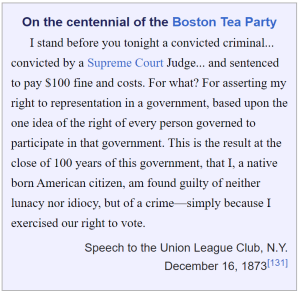 While the immediate result of Anthony’s trial was not a legal victory for women’s suffrage, it had a profound impact on the movement by drawing national attention to the cause. Anthony used the trial as an opportunity to amplify her message, embarking on a speaking tour and discussing the details of her case and the broader issue of women’s rights.
Her tireless efforts, along with those of fellow suffragists like Elizabeth Cady Stanton, paved the way for the eventual ratification of the Nineteenth Amendment in 1920, which granted women the right to vote. Although Susan B. Anthony did not live to see this momentous day, having passed away in 1906, her relentless activism was instrumental in its realization.
Susan B. Anthony’s life is a testament to the power of conviction, resilience, and the belief in the fundamental equality of all individuals. The events of November 5, 1872, serve as a poignant reminder of the sacrifices made by countless women in the struggle for equal rights. While the immediate consequences of her actions were punitive, the long-term effects reverberated through history, culminating in the Nineteenth Amendment and ensuring that future generations of American women could have a voice in their democracy.




 DAVE DOES HISTORY
Leave a comment