
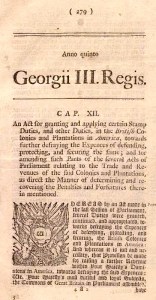
On November 1, 1765, the Stamp Act went into effect in the American colonies, marking a seminal moment in the unfolding drama between Great Britain and its colonies across the Atlantic. This legislation was intended to generate revenues for the British government by imposing a direct tax on a wide range of documents, from newspapers and wills to playing cards and legal contracts. Its enactment and the subsequent responses set the stage for the series of events that would ultimately culminate in the American Revolution.
Public Domain
The Seven Years’ War had left the British treasury drained, and the government sought new revenue streams to recoup its financial losses and to fund the defense of its sprawling empire. The colonies, having been the beneficiaries of British protection against French and native incursions, seemed to the British officials as a logical source of revenue. They expected the Stamp Act to be a straightforward way to raise money, justifying it as the colonies’ contribution to their defense.
British society in the mid-18th century was not the monolithic entity we might imagine today. While some segments of the British media and populace supported the government’s decision, believing the colonies should bear a part of the defense costs, others were more sympathetic to the American perspective. Radical publications and prominent figures of the time expressed reservations about the wisdom and justice of taxing the colonies without their representation in Parliament, echoing the colonial slogan, “No taxation without representation.”
The colonies’ initial reaction to the Stamp Act was overwhelmingly negative. The idea of being taxed directly by the British Parliament – especially without colonial representation – was seen as a gross violation of their rights as English subjects. The reaction manifested in various ways:
1. Protests and Demonstrations: Organized protests took place in various cities, with crowds often effigying or even attacking the appointed stamp distributors.
2. Stamp Act Congress: In October 1765, representatives from nine colonies met in New York to draft a formal letter of protest to the British government. This was one of the first coordinated inter-colonial political actions.
3. Boycotts: Merchants in major colonial cities initiated a boycott of British goods, which proved effective in pressuring British merchants to lobby against the Act.
4. Violence: Some of these protests turned violent. The homes and offices of those affiliated with the enforcement of the Act were sometimes targeted by angry mobs.
The intense colonial resistance made it clear that the Stamp Act was not only unpopular but also nearly impossible to enforce. Recognizing this, and under pressure from British merchants feeling the effects of the colonial boycotts, Parliament repealed the Stamp Act in 1766. However, alongside the repeal, Parliament also passed the Declaratory Act, which asserted its right to legislate for the colonies “in all cases whatsoever.”
The ultimate effect of the Stamp Act was profound:
1. Emergence of Colonial Unity: The Act sowed seeds of unity among the previously disjointed colonies. It fostered a sense of shared identity and purpose against perceived British overreach.
2. Foundational Ideologies: The ideological grounds for the American Revolution were laid during this period. The debates around the Stamp Act crystallized ideas about representation, rights, and the relationship between the colonies and the mother country.
3. A Prelude to Revolution: While the Stamp Act was repealed, the pattern of colonial resistance and British response continued with the subsequent Townshend Acts and the Intolerable Acts, setting the stage for the American Revolution.
In retrospect, the Stamp Act represents a pivotal moment in colonial-British relations. While intended as a simple revenue-raising measure, its ramifications were immense, sparking a series of events that would forever change the course of history.




 DAVE DOES HISTORY
Leave a comment