
The Battle of Chantilly (also known as the Battle of Ox Hill) took place on September 1, 1862, in Fairfax County, Virginia, during the American Civil War. It was a crucial yet often overlooked battle that followed the Second Battle of Bull Run (or Second Manassas).
After the Confederate victory at the Second Battle of Bull Run, General Robert E. Lee was looking for an opportunity to strike at the Union Army of Virginia, commanded by Major General John Pope, before it could join forces with the Army of the Potomac under Major General George B. McClellan.
Lee sent Stonewall Jackson’s wing of the army on a flanking march to cut off Pope’s line of retreat to Washington. As Jackson moved, elements of his force clashed with Union troops near the Little River Turnpike.
The weather on that day was dismal, with severe thunderstorms complicating the battlefield conditions.
Union forces at Chantilly were led by Generals Isaac Stevens and Philip Kearny. They launched assaults against the Confederate divisions under Generals Alexander Lawton and Jubal Early. However, the rain, combined with the fierce Confederate defense, made the assaults ineffective.
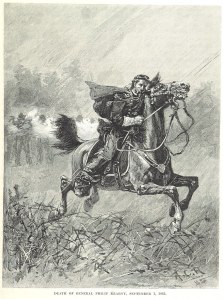
Public Domain
Tragically, during this battle, both Union Generals Stevens and Kearny were killed. Kearny, in particular, was a significant loss for the Union, as he was considered one of its most competent commanders.
The battle ended inconclusively, with both sides suffering casualties but neither gaining a decisive advantage. The Union reported 1,300 casualties, while Confederate losses are estimated at 800.
However, the battle had larger implications:
1. **Union Retreat**: Despite not achieving a decisive victory, the Confederates achieved their strategic objective. The Battle of Chantilly slowed down Union forces just enough to allow Jackson to complete his flanking movement. This put Pope’s army in a vulnerable position, ultimately forcing it to retreat to the defenses of Washington, D.C.
2. **Consolidation**: The Battle of Chantilly marked the end of the independent existence of the Union’s Army of Virginia. Its units were merged into the Army of the Potomac, with McClellan taking over the unified force’s command. This move was controversial, as McClellan was a cautious commander, but President Lincoln felt he was the best option available.
3. **Confederate Momentum**: The indecisive nature of the battle still provided Lee with a sense of momentum. After the engagements at Second Bull Run and Chantilly, Lee felt confident enough to launch his first invasion of the North, leading to the Maryland Campaign and the Battle of Antietam later in September 1862.
While the Battle of Chantilly itself was not a decisive engagement, it played a role in the larger strategic picture. Lee’s momentum would be halted at Antietam, the bloodiest single day in American history. The Union’s strategic victory at Antietam provided President Lincoln with the confidence to announce the Emancipation Proclamation, which transformed the nature of the Civil War from a conflict to preserve the Union to a struggle for freedom and abolition. In this way, the events at Chantilly indirectly set the stage for one of the war’s most significant turning points.

By Clindberg – Own work, CC BY 2.5, https://commons.wikimedia.org/w/index.php?curid=1302403

 DAVE DOES HISTORY
Leave a comment