
Krakatoa is a volcanic island located in the Sunda Strait between the islands of Java and Sumatra in Indonesia. Its eruption in 1883 is one of the most infamous volcanic events in recorded history due to its sheer explosiveness and subsequent global consequences.
Prior to the paroxysmal eruption, Krakatoa had been exhibiting increased volcanic activity for several months. Eruptions began on May 20, 1883, and continued sporadically over the next few months, with ash emissions and tephra (rock fragments) being ejected.
August 26, 1883 The climax of the eruption occurred on this day. Four colossal explosions were reported:
– The first explosion occurred at around 5:30 AM.
– The second explosion, which was even more violent, occurred at about 6:44 AM.
– The third and largest explosion took place at 10:02 AM. It produced the loudest sound ever historically reported: heard up to 3,000 miles (4,800 km) away. It’s estimated that this explosion was equivalent to 200 megatons of TNT.
– The fourth explosion, occurring in the late afternoon, was noted to be less intense than the previous ones.
Each explosion was accompanied by very large tsunamis, with waves reaching heights of up to 40 meters (about 131 feet). These tsunamis devastated nearby coastlines, particularly the shores of Java and Sumatra. Over 36,000 people lost their lives, with many of the casualties resulting from these massive waves.
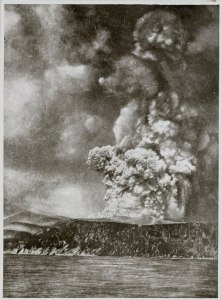
CC 4.0
The eruption produced hot clouds of ash, gas, and volcanic debris known as pyroclastic flows. These flows raced across the surface of the sea, scalding and incinerating everything in their path. They traveled at incredibly high speeds and were responsible for a significant number of deaths.
The amount of ash and sulfur dioxide released into the atmosphere had far-reaching effects. It caused vivid sunsets and a noticeable temperature drop worldwide over the following year due to the reflection and scattering of sunlight by the airborne particles. This phenomenon is sometimes referred to as a “volcanic winter.”
Two-thirds of the island of Krakatoa collapsed during the eruption, forming a caldera that was filled by the sea. This led to the formation of a new volcanic island, Anak Krakatau (meaning “Child of Krakatoa” in Indonesian), which rose from the sea in 1927 and has been growing ever since, continuing the volcanic legacy of its predecessor.
The 1883 eruption of Krakatoa is a testament to the immense power of nature and remains a focal study point in both geology and vulcanology due to its significant global impacts and the lessons it provides in understanding volcanic hazards.
As a aside, the eruption was said to be the inspiration for Edvard Munch’s The Scream…




 DAVE DOES HISTORY
Leave a comment